Having featured hand winders, automatics and electro-mechanical examples, I thought I’d kick off 2012’s Featured Watches with the other type of movement I cover in the time frame of my collection – the electronic ‘tuning fork’ watch. Although made as a Citizen watch with its own ‘Hisonic’ name, the movement is in fact the Bulova Accutron which was licensed to a range of other manufacturers. Through this arrangement Citizen was able to bring this technology to the Japanese market for the first time, in 1971, using the 218 and 219 Bulova versions. Citizen manufactured the movements themselves, giving them their own movement numbers, and later supplied parts to Bulova. I understand American made Bulova parts and Japanese made ones are inter-changeable. Citizen’s version of the 218 Accutron was used in the Hisonics whilst the 219 was used in a Cosmotron model – more of that when I do the Cosmotron article.
The tuning fork movement significantly raised the bar in terms of watch performance – Bulova gave written guarantees that the watch would lose or gain no more than one minute per month. Here’s a really excellent article which gives lots of historical and technical information: http://members.iinet.net.au/~fotoplot/acc.htm
The advent of quartz technology killed off tuning fork watches, with production ending around 1977, so the Hisonics were produced for only a short while. They are high end time pieces – in Citizen’s 1973 catalog the cheapest retailed at JPY35,000, rising to JPY60,000.
My example is from September 1973, and would have cost JPY38,000 at the time:

The dial is marked ‘tuning fork’ and ‘hisonic’ along with the applied tuning fork logo – here you can see how the second hand has a solid centre, combined with a black and steel hand set:

Running at 360Hz, i.e. 360 steps per second, the sweep of the second hand is exceptionally smooth – here’s a one second exposure of the ‘beat’:

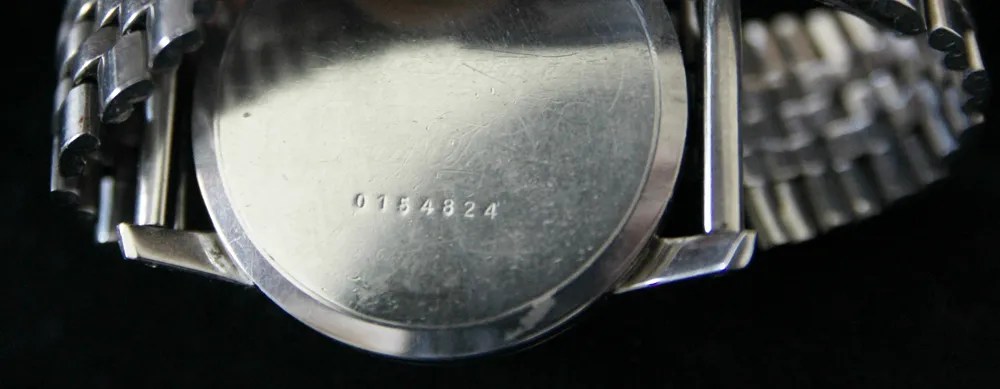
The movement in this is the 3701A – the date and day version, shown on the back. Some models had a gold medallion on the back rather than an engraved centre as here (the scratches are actually in the plastic film still on the watch a the time). The back is held by screw-in ring, and has a location tab so it only fits at this position:

The crown is signed – in normal position the date can be quickset, at one click out the watch is hacked and time can be set, at second click (fully out) the battery is fully disconnected when the watch is not in use:

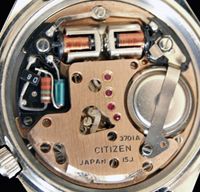
Here’s the movement, with a nicely finished top plate – important to note that the battery is placed positive side down:

Here’s the license acknowledgement stamped at the top of the movement:

An original leather strap, with signed buckle:

The case measures about 38mm across, and about 41mm lug to lug:

I acquired this one in non-working condition, so it was not expensive despite its very nice condition. Luckily it was brought to life by Paul at ‘Electric Watches’, who is the go-to guy in my opinion for servicing and repair of electric / electronic vintage watches. I’ve added a link to his site in my Blogroll.
The watch is running very well, and is very accurate – I wore it over New Year and could see no discernible deviation over about 5 days 🙂