Just uploaded the latest version of the Table, which now has a corrected entry for the Square Custom. This has taken me rather longer than anticipated, due to a major computer problem – system disk failure 😦
Now back up and running, fortunately!
Just uploaded the latest version of the Table, which now has a corrected entry for the Square Custom. This has taken me rather longer than anticipated, due to a major computer problem – system disk failure 😦
Now back up and running, fortunately!
If you have a question about a vintage Citizen, please feel free to ask via a ‘comment’ here. I’ll do my best to answer and help with any information I might have.
Had an interesting time getting at the movement, but was well worth it, since it has clarified which movement is used and leads to a slight Movement Table amendment….
First though, here’s a look at the case and how to remove the back. The bracelet has to be removed first of all, which reveals a spring between each set of lugs:

The springs are pressed in to release the back:

The crown / stem is in two parts , which is loose once the back is removed since it’s secured by the upper case. Here’s the inside of the case back clearly showing the integral springs:

Looks like the case design was patented by Citizen from the mark inside the case back – this pic shows the loose crown / outer stem:

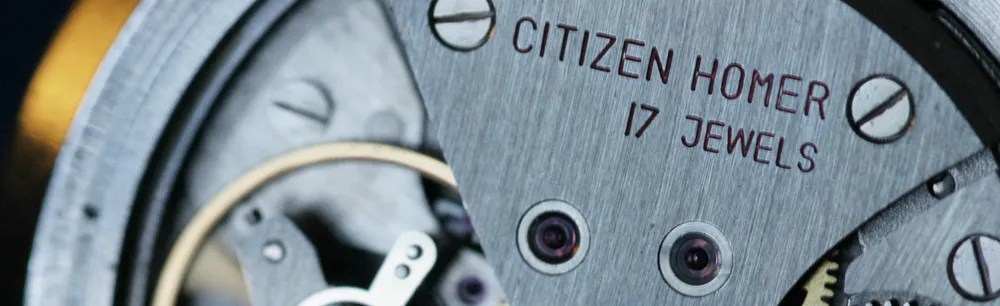
And here’s the movement, the number is stamped to the lower right of the balance wheel:

And the movement number? Turns out it’s 5204, which was introduced in 1965 in the Crystal Seven line, and was then found in the quirkily named ‘Dandy Seven Custom’ in 1968.
Putting it back together is of course the reverse of dismantling, with care needed both to keep the gasket inside the upper case correctly in place and to locate the lug on the outer stem in the inner part before pressing the back into place.

Enough of round cases, here’s a bit of angular stainless steel! The Square Custom was one of the models in the 52xx movement range first produced in 1965 along with the Seven Star and Crystal Seven lines. The Square Custom featured the highest jewel count – 27 – reflecting it’s position as an upper mid-grade piece:

The 40mm by 34mm case gives a chunky look, and the separate day and date windows add interest. The framed circular date window contrasts with the right angles, and I like the way the wheel is printed so that the date is displayed vertically rather than at an angle unlike more modern takes on this configuration.
I believe this one is on its original solid link bracelet:


The serial number shows production in December 1970:

I haven’t removed the case back on this yet – it’s done by removing the bracelet and pushing in a clip between the lugs. I really must do this so I can check the movement number and confirm it in the Movement Table – hopefully I can add that info soon in a ‘Part 2’ post.
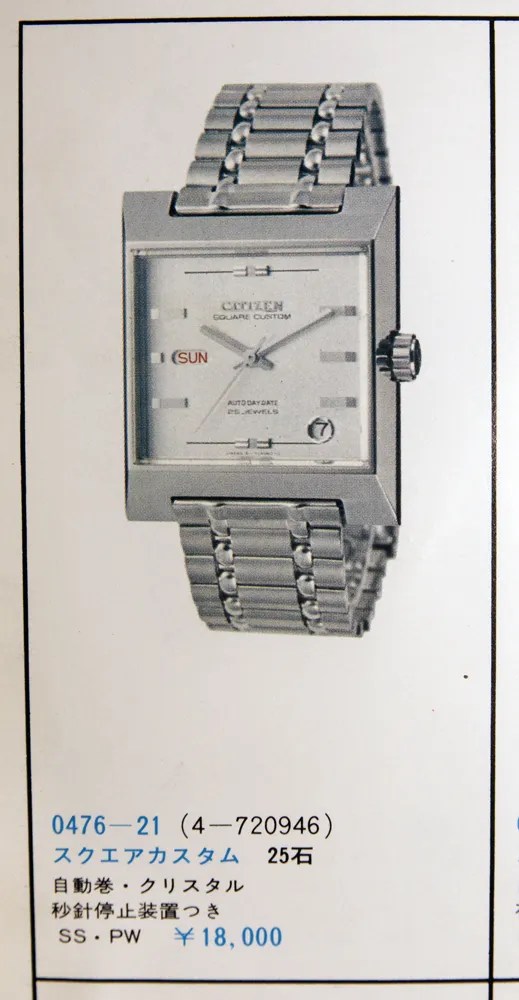
Citizen also produced the Square Custom a little later using the 25 jewel 72xx movement launched in 1969. There was also a variant sold with curved sides – same movement but retailing at a lower price. Here are 1971 catalog pictures of the two types, also showing the same bracelet as on my example:

Maybe this design is not to everyone’s taste, but it certainly has impact in my opinion:

Battery life for Citizen’s electro-mechanical watches was advertised as 12 month. I have run one of mine constantly to see what period of time I would get. Here’s the watch, from 1975:

It had a new battery fitted by the seller when I bought it in May 2010, and it ran out of juice yesterday. So I got more than 18 months from the battery – not too bad at all 🙂
Here’s a second example of a Leopard with an oval dial. This is the 4-720911 model, again with the 7230 movement running at 36,000 beats per hour (10 per second). This has a grey dial, with lumed hour markers and black, lumed, hour and minute hands:

This dial is marked 36000, but also has the leaping cat logo:

Here are scans from the 1971 catalog, showing this one and the 4-720903 model featured in Part 1 (although mine, from 2 years later, has no leaping cat). Note the slightly different case designs, with the grey model having a more cushioned shape, being wider at the lugs, and the mesh bracelets often used in the Leopard line. Both these models retailed at JPY26,000 – more expensive than a couple of Chrono Master models at that time:

The Leopard line is a favourite of mine, with its range of high beat watches beating at either 28,800 beats per hour (8 beats per second) or 36,000 beats per hour (10 beats per second). Launched in 1969 and produced into the mid-1970’s, there was a good number of models, mostly in traditional style, although some were also influenced by 1970’s style. The higher beat models are the more sought after, and are scarcer too.
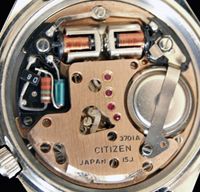
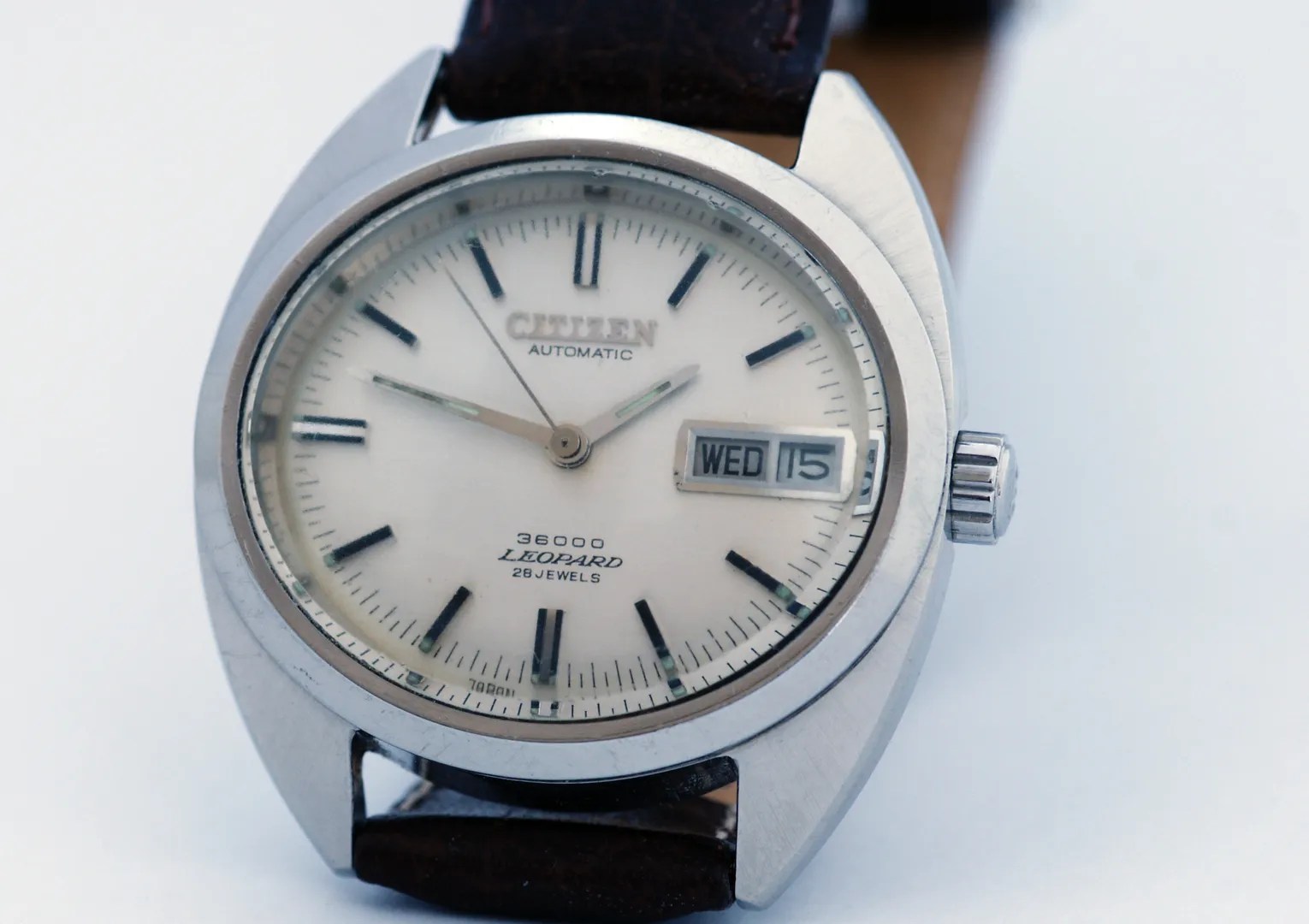
One of my earliest Leopard purchases is a 36,000 bph model, in an oval case. It was described as running erratically, if at all:
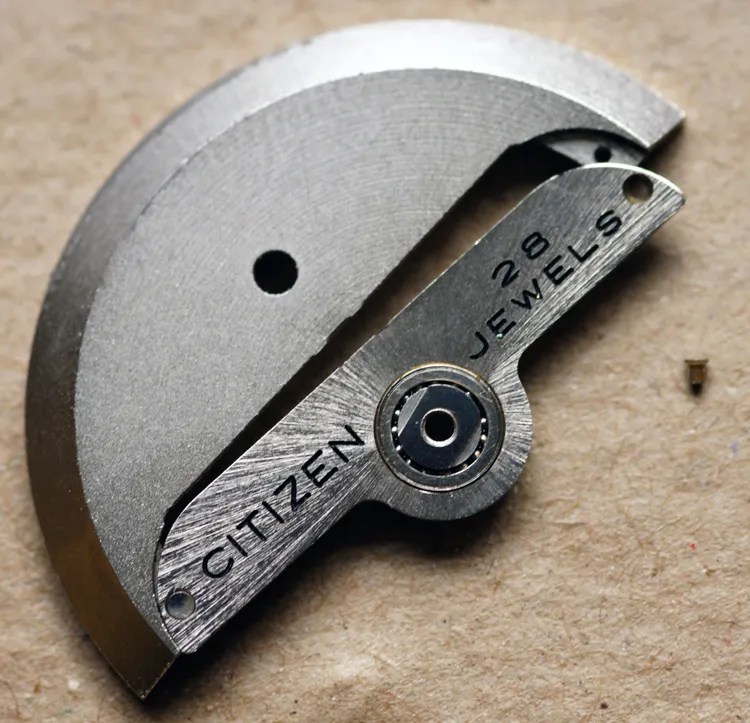
The crystal was well worn, but was the original mineral glass. When I opened it up, I found a broken rotor, but fortunately the missing rivet was still in the case, so I was able to fix it, and, of course, solve the erratic running!:
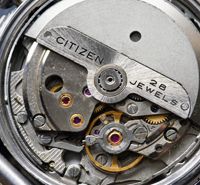
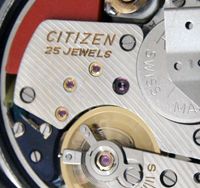
The 28 jewel movement found in the 36,000 versions otherwise looked ok. You can see the fine adjuster on the balance and the hacking lever found on all Leopards, and note the movement number – 7230 in this one – stamped near the lower right edge of the movement :

Under the scratched glass, the dial was not in bad order, although the lume on the main hands is rather tired! The ‘tail-less’ second hand is a design found on a few of Citizen’s models. This dial is marked ‘36000’, some also have ‘Superbeat’ markings and a rather nice leaping cat logo:

The case back shows it was the 39th watch prodced in November 1973:

The chunky crown – a good size for hand winding which is a feature of all the Leopards – is signed. Date quick sets at first step, whilst day is set by winding back and forth between 12 and 9:

After a long time hand polishing the glass, it was significantly improved, reducing the yellowness of the dial as well as the scratches, and after the rotor repair, the watch runs well:

For more info on the Leopards, follow the Blogroll link on the right where you can find my reference article on these great timepieces.
Thanks to JAY48 (SCWF) I’ve been able to confirm the dial code of the black 67-9356 (octagonal case), and I’ve just acquired a 67-9631 (blue dialed 8100) so I’ve changed the picture and confirmed the dial code. This is a rare piece – I was very pleased to find it!
If you think a watch looks to be beyond both hope and help, just take a look at this thread in the Watchuseek Seiko & Citizen Forum and especially the great work being done by ’31 Jewels’;
http://forums.watchuseek.com/f21/citizen-8110-model-high-end-watch-617679.html
After covering later technology utilising electronics in the previous couple of featured watches, this week I return to the humble hand winding tradition, and a significant watch for Citizen. Generally the ‘Deluxe’ was important because it was a commercial success, selling many millions in Japan, but this model was notable because it was the first, in 1959, to carry the ‘Parawater’ logo. After that, until around 1970, ‘parawater’ was Citizen’s term for ‘waterproof’ and many of its models carried the logo until then.
As the first waterproof model, this one tends to be described as the Parawater.

It uses the stock 2B/9200 Deluxe movement, but for the first time Citizen used waterproof gaskets and most importantly, a new design for the crown and tube assembly:

The system was tested in June 1963, when an example was floated across the Pacific on the Kuroshio (the Black Current) in a special buoy, to prove it’s effectiveness when swimming (this was not designed for diving of course).
My example is far from pristine, but has a nicely aged cream dial:

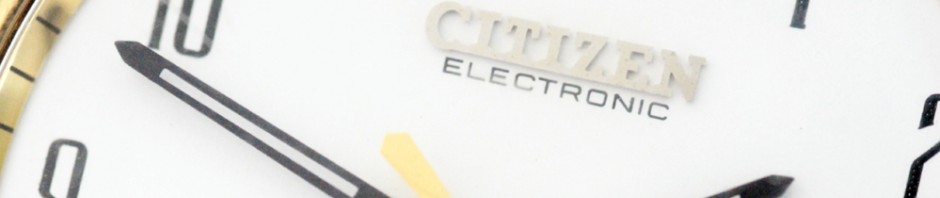
The Parawater logo has pride of place on this model, reflecting the importance of the new feature. The logo is applied, whilst the ‘Deluxe’ name is printed at the 6 o’clock position:

The worn case back at least shows the serial number, showing production in January 1960:

Produced in 19, 21 and 23 jewel variants, this one has 23:

More info on the Deluxe, including a couple of examples of the Parawater, can be found on the Deluxe page, here: https://sweep-hand.org/the-deluxe/