This Week’s Featured Watch #27 – the 520 Auto Dater

One gap that I was aware of in the Movement Table was for the 520 Auto Dater. Although I had seen examples of this model, I hadn’t got my hands on one, nor had I seen a detailed shot of the movement – so I couldn’t be absolutely sure of where it would fit. I presumed it would be related to the 540 Auto Dater, which is a date only model from the movement family used in the Crystal Sevens. The 540 seems to pop up a little more often (or should I say a little less infrequently!) and I had acquired one a little while back, and show briefly in this post: https://sweep-hand.org/2011/11/06/the-5400-autodaters/

So I was pleased to find a 520 recently, and I have now been able to add it to the Movement Table:

As expected, the 520 is ‘named’ after the movement it uses, and is a day / date model. Again this is as expected, since Citizen’s convention in their movement numbers is generally (but not always!) to use the first number ‘2’ (i.e. 5202) to indicate a day and date watch, whilst the first ‘4’(i.e. 5400) indicates date only.

I’m not sure whether anything other than 21 jewels were used in this movement, although I know the 5203 also came with 23, 27 and 33 jeweling – perhaps they were reserved for the Crystal Sevens. The movement hand winds, but no hacking, and has quickset date with the crown pulled one step out. Day is set by winding back and forth between 12 and 9 o’clock:

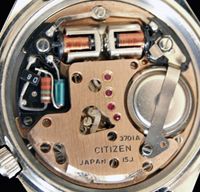
And here is the movement number, 5203, stamped in the usual place:

So this movement is the same one found in some of the Crystal Seven models – but since this watch is a plain 520 ‘7’, then I presume it lacked the hard mineral glass used on the ‘Crystal’ versions. But it still has nicely finished hour markers at 12, 3, 6 and 9 o’clock positions:

With the transition from the thicker ‘jet’ movements to the oscillating weight type, the 520 is a fairly slim model:


The back is typical of its day, showing October 1966 production (I guess production was started in 1965, as for the Crystal Seven) :

Finally, the fluted bezel design as was often seen in the mid 1960’s:

Posted in Vintage Watches | Tagged , , | 36 Comments

Quick Access to the Featured Watches

I’ve added a page for links to the ‘This Week’s Featured Watches’ posts, to give direct access to the relevant posts.

Posted in Vintage Watches | Tagged | Leave a comment

Smooth as butter – the Hisonic Tuning Fork Sweep

If you’ve ever wondered what 360 beats per second looks like……..

http://s282.photobucket.com/albums/kk252/Sweephand/HiSonic/?action=view&current=MVI_0455.mp4

There’s more info on the watch here: https://sweep-hand.org/2012/01/07/this-weeks-featured-watch-19-the-hisonic/

Posted in Vintage Watches | Tagged , | Leave a comment

Movement Table Updated to v3.3

Just updated the table to include the 520 Autodater, and made a couple of other minor revisions.

Posted in Vintage Watches | Tagged , | 24 Comments

This Week’s Featured Watch #26 – The Junior

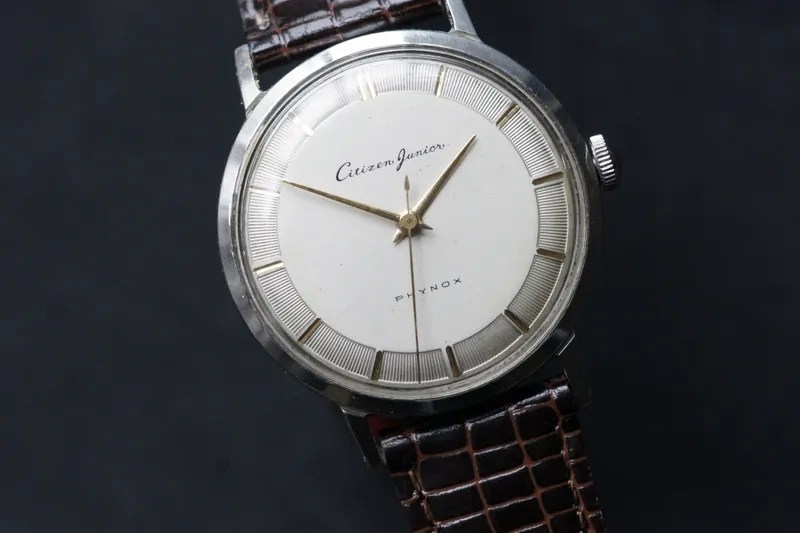
Citizen introduced the ‘Junior’ in 1958, a development of the ‘Center Second’ line. Using the 2S/910 movement, it came in 9, 11, 15 and 17 jewel variants. There was a wide variety of dial styles, including some quite fancy designs (how does a tartan dial appeal?!) and three now sought after models picturing respectively a sailing ship, the Matterhorn and a map of the world. The same movement was also used in Citizen’s first ‘Shine’ model, for use by blind people (i.e. a hinged glass with braille type hour markers).

Most of the model range carry the Parashock logo, after the shock resistance system was introduced in 1956. Some models though were made without this and simply show ‘Phynox’ on the dial – this is the alloy used in watch springs.

My example is the lowly 9 jewel model. However, despite this it has some nice features often seen in watches of this age, notably the gold plated engraved hour markers and the hand set:

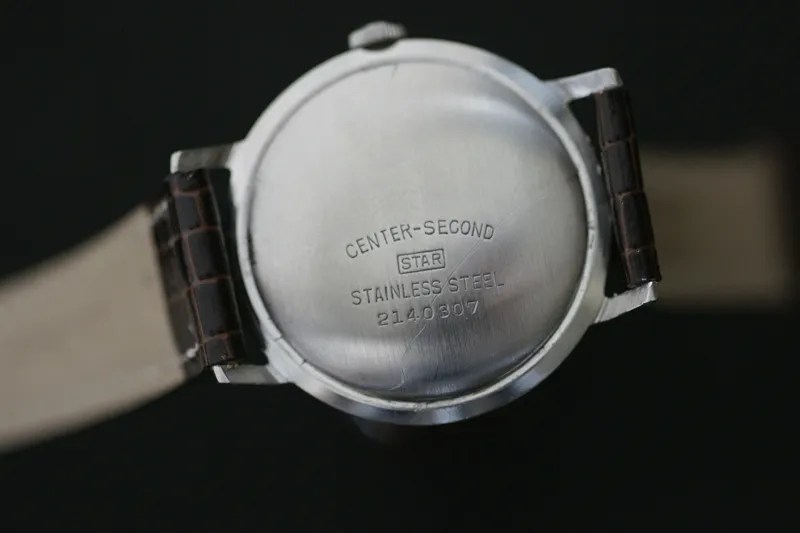
The number on the back is I believe a case or model number rather than a serial. No serial number is stamped on the inside either:

Here’s the movement, you can see that there is no anti-shock system on the jewel above the balance spring pivot:

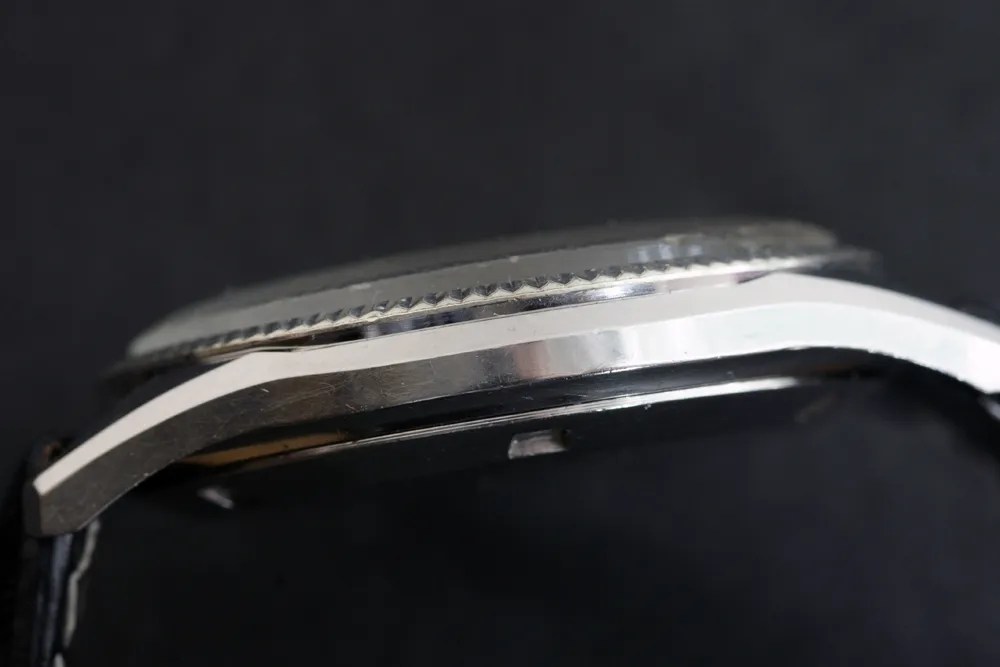
Typical of its time, the lugs are drilled:

Finally, we’ve seen the second hand design on this before…on the first electronic watch in fact, which cost around 10 times that of the Junior:

The Junior is a good example of an inexpensive early watch that, despite its price, was produced to a decent quality level.

Posted in Vintage Watches | Tagged , | 3 Comments

Note on the 5290 Movement

I just noticed that I had described the 5290 movement found in the Seven Star Yacht Custom and Rally Custom models as not hacking, when in fact it does – good job that I’m wearing the Rally Custom tonight!

Apologies for the mistake, I’ve now edited the Week 24 Featured Watch accordingly.

Posted in Vintage Watches | Leave a comment

Custom V2 Trio

Early 1970s styling, courtesy of Citizen’s Custom V2 line.  Two of these have been featured in the past couple of weeks – lots of colour, black cases and a decent size reflect the introduction of new design at the end of the 1960s. Maybe not everyone’s cup of tea, but they certainly made a statement!

Posted in Vintage Watches | Tagged , , | 4 Comments

This Week’s Featured Watch #25 – the Custom V2 ‘Blackie’

Staying with the ‘Custom’ models, this week is one of Citizen’s first black coated models to reach the market in 1970. Nicknamed ‘Blackie’ models, the new coating was used over a light alloy case to reduce weight and improve scratch and wear resistance.

The 7290 ‘hacking’ automatic 23 jewel movement is used, running at 21,600 beats per hour, this one originally retailed at JPY13,500:

The main hands on my example are probably not original – I believe they should be black with orange lume – and the day wheel should also be black. It also has the wrong case back, so this is not my best buy! (it was an early purchase, before I acquired greater knowledge ;))

But for now it is my only example of this particular model – so here’s a closer look at the dial with it’s rather neat raised hour markers and ‘tail-less’ second hand:

The 7290 movement, typically marked:

The movement number clearly stamped:

And finally here’s how it was in 1970!:

(image courtesy of Citizen Japan)

Posted in Vintage Watches | Tagged , | 4 Comments

This Week’s Featured Watch #24 – the Yacht Custom

In the late 1960s Citizen turned their hands (I know, bad pun!) to making a small number of sports watches, as part of the Seven Star line. As well as a couple of diver models, they made three ‘custom’ models designed for rallying, soccer and sailing. None of these models are commonly seen these days, but the latter two are particularly rare, and examples in good condition are especially hard to find.

This week’s model is the sailing variant – the Yacht Custom. My example is well past its prime, but is runnning well and is one of only a very few I’ve seen. As with the other models in this line the case is rated to 100meters, and features a 60 second countdown counter on an inner rotating ring (similar therefore to the ring on the 67-9119 chronograph model). The case is a decent size, measuring 41mm across, excluding crown, and 43mm lug to lug.

The glass is significantly scratched, the black dial is worn and the lume on the hour markers has largely gone and the orange paint at the 55 to 60 second segment of the countdown timer has almost completely faded:

The crown at three o’clock winds and sets the watch – the date quick sets at the first step, whilst the day is set by winding back and forth at 12 o’clock. Day language is English only. The lower crown rotates the inner ring.

The case and back are in decent shape, with serial number showing production in May 1969, whilst the case number indicates that this model uses one of the 52xx movements:

Although not that clear from the first picture, the movement has 25 jewels, so it is at the top end of the Seven Star series, which also came with 21 and 23 jewel variants. However, along only with the Rally Custom, the Yacht Custom 25 jewel movement is designated 5290 rather than 5270, as seen in the rest of the Seven Star series (note: the Soccer Custom uses the 21 jewel non-hacking 5270 caliber). The automatic movement runs at 18,000 beats per hour and hacks as well as hand winds:

When new, these retailed for about JPY12,500. Here’s a scan showing the piece in better condition:

The Seven Star model was not the only ‘Custom’ model to use this countdown ring, since two Custom V2’s also made use of it in the early 1970s, one with a grey dial and blue highlights – although Custom V2 models are often seen for sale, I have yet to see another one of this particular model for sale:

The case design appears to be the same as the Seven Star original, but the ‘Yacht Custom’ logo has been dropped, nor is it depth rated. The movement used now is one of the 72xx series, launched in 1969, whilst this one was produced in April 1970:

Now with the 21,600 beats per hour 7290 23 jewel movement, this one hand winds and hacks:

This model retailed at JPY15,500, so was a mid-range watch, similarly priced to the cheapest (high beat) Leopards.

These sports models, together with their diver contemporaries, were the largest of Citizen’s vintage pieces and are an interesting and somewhat rarer sub-set of their more frequently seen model lines.

Posted in Vintage Watches | Tagged , , | 10 Comments

This Week’s Featured Watch #23 – the Homer

The humble ‘Homer’ was Citizen’s workhorse hand wind movement for many years. First produced in 1960 I believe it was produced right through to 1980 or so, not only in Homer badged models but in others as well – notably the ‘Newmaster’. It was also used in some Rhythm Time models. The Rhythm Time company was affiliated to Citizen in the 1950s and produced entry level mechanical watches, often in smaller sizes  for youngsters.

This post is about the first and simplest Homer model, which used the 0200/0201 movement. Other Homers were made with date and day windows, but they are for another day…..

When first launched the Homer was most commonly produced in gold plated cases, which were more popular in that era. And despite their humble place in the quality hierarchy early models often featured textured and patterned dials, whilst some had hexagonal and square cases. Hopefully I’ll show more of them when I do a page / article on the range.

In the early 1960s there were also a few Homer variants – the ‘Guppy’, the ‘Special’ and, featuring red, yellow or green dials – the ‘Pansy’.

The 0200/01 movement was initially made with 17, 19 or 21 jewels, later it was also seen with 7 jewels as costs were kept down for the younger market. Here’s a shot of the 17 jewel variant:

Here’s my early Homer – this one carries the Minolta company logo on the dial, which has some spotting which is all the more apparent when photographed!:

The dial carries the ‘Parashock’ and ‘Phynox’ text typical of earlier models, has a nicely finished chapter ring around a brushed centre and engraved hour markers:

Made in April 1963, this special edition for the Minolta company has nice low production number of 13:

And now let’s fast forward 10 years…..this 21 jeweled example is from May 1973, and the Homer logo has been dropped:

The stylised crown marker at 12 o’clock is also seen on the ‘Newmaster’ models, whilst the case back is now screwed on  rather than a snap on type.

Finally, here’s an example of the Rhythm Time versions – same movement but in a smaller case, suitable for a teenager:

The case is chrome plated (‘CCP’), reflecting that this was an inexpensive watch:

The movement in this is clearly lower quality to keep costs down, with just 7 jewels and crudely stamped marks. Despite that this one has been serviced by the look of it:

Why the name ‘Homer’? I don’t really know the answer to that, but the Greek meaning of it I believe is to do with ‘security’ or a ‘pledge’ – makes sense that this was chosen since this movement has proved to be very sound and reliable.

Posted in Vintage Watches | Tagged , | 27 Comments