
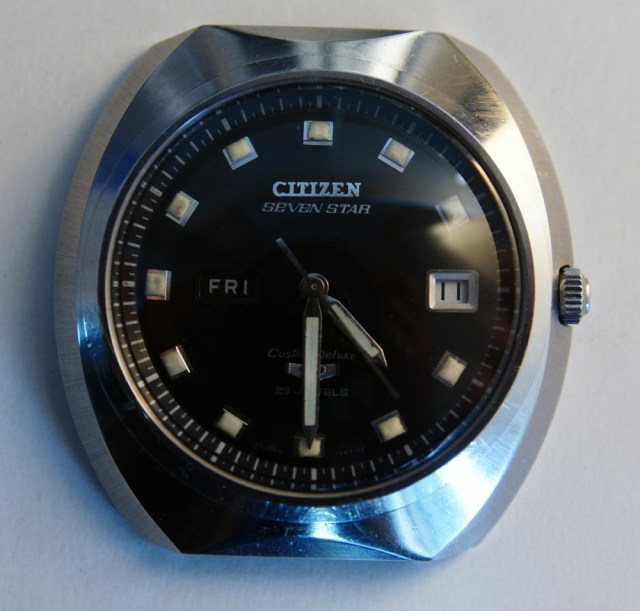
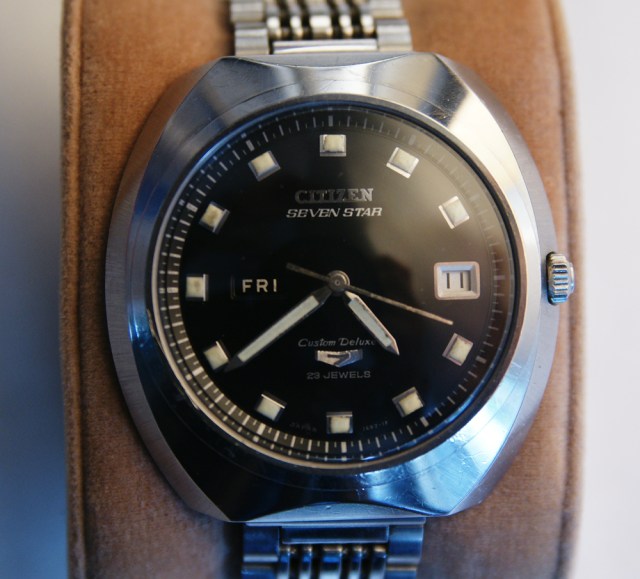
This week’s watch might be called a Leopard that has lost its spots 🙂 I came across this model for the first time recently, case number 4-722132, with 26 jewels, from August 1971:

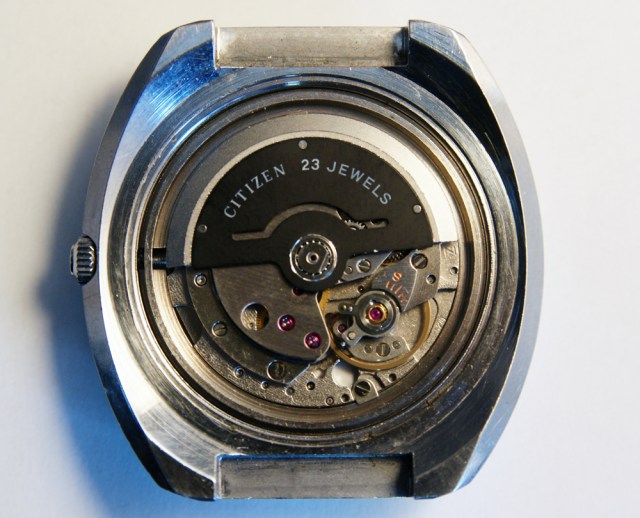
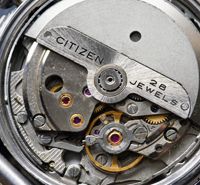
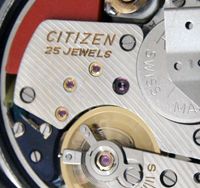
Although the 7200 movement with 26 jewels runs at 21,600 beats per hour (bph), the 7210 variant runs at 28,800 bph and is one of the Leopard family. I noticed that this example had a fine adjuster on the balance, a clear sign of a high beat movement. However, with no Leopard, ‘Superbeat’ or 28,800 logo on the dial I was intrigued – in fact for another reason which I’ll come to shortly I was doubly intrigued. On arrival I quickly found 7210 stamped on the movement, so confirmed it’s the high beat version:


Before buying I had of course wondered if it may be a so-called ‘franken’ watch, i.e using parts from different models. But I was able to find a couple of other examples of this watch, both with the exact same markings, and also without any of the usual Leopard’s markings. I could also see that the same dial code was evident, and one that is appropriate for a 72 model – 6-724850. So I am happy that this is a genuine model, and the first ‘Leopard’ that I have found without its ‘spots’.
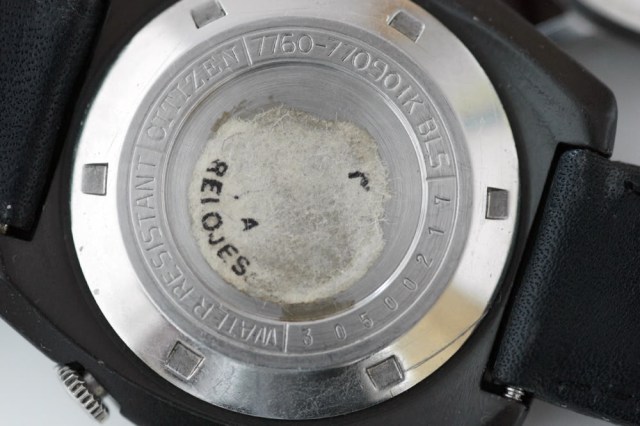
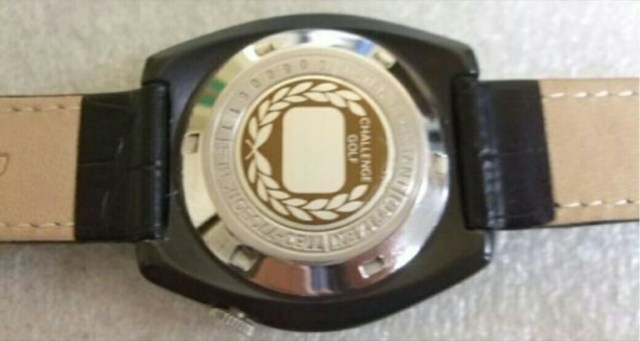
The other feature that intrigued me is the bezel material, indicated by the case back code:
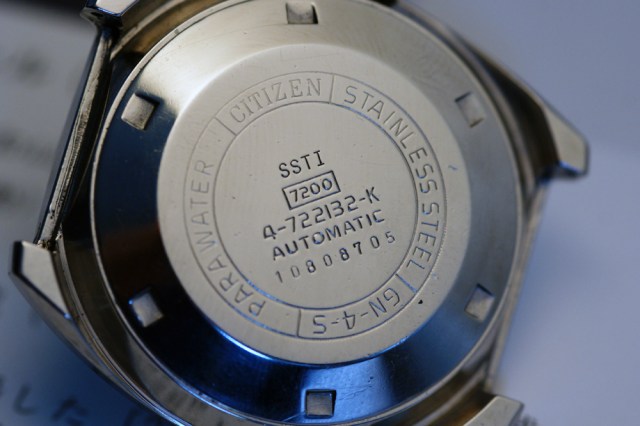
I have seen ‘BLTI’ before, i.e on a black coated case, but not ‘SSTI’. See my example here: https://sweep-hand.org/2011/10/19/this-weeks-featured-watch-15-6501-with-tungsten-bezel/
I’ve been working on Citizen’s case material codes lately, and although these ‘TI’ codes are unfortunately notable by their absence, Citizen used Titanium Carbide (TiC) and Titanium Nitride (TiN) so could this bezel be TiC (as opposed to TiN which is gold coloured)? But it now gets a bit more complicated! On other, slightly later models, Citizen used UHA (TiC) and UHAG (TiN) for their carbide cases and bezels, whilst I’ve seen some descriptions of TI bezels as tungsten carbide, hence my description of the BLTI model as tungsten. My titanium (not carbide) cased X8 Chronometer is marked TN….It’s possible therefore that Citizen used tungsten carbide at first, using TI as the material code (for a reason that is somewhat lost on me!) and then adopted UHA for their Titanium Carbide models. I noticed on another example of this watch that the bezel was chipped on one side. Although tungsten carbide is very hard, it is relatively brittle, so that damage lends some additional credibility to it being that material, perhaps replaced later by titanium carbide as a better option. Any thoughts/more information is very welcome!!
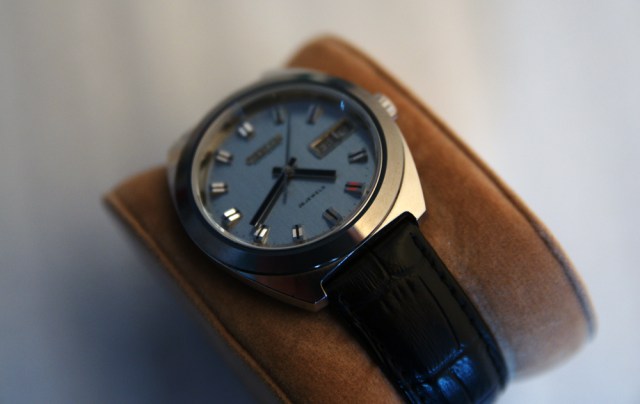
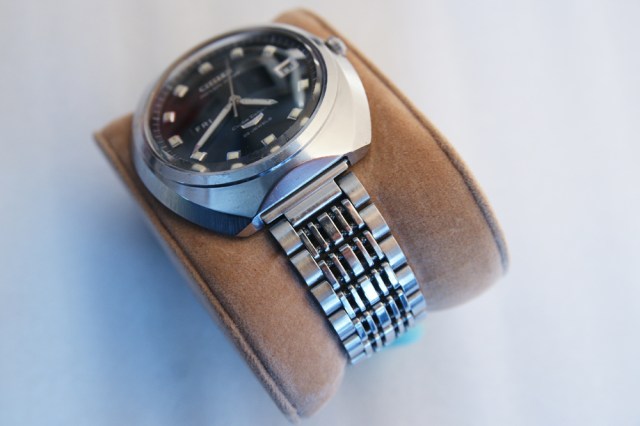
Whatever the exact material of the bezel, from a cosmetic point of view it has an attractive grey appearance and certainly shows little or no signs of wear:

All in all this is an interesting watch, with a good quality movement and an unusual case material and bezel combination.









 Sweephand's Vintage Citizen Watch Blog