What Makes This Cosmotron Special?

There are a number of things that can make a watch ‘special’ – it may be an expensive high grade piece, or it might be a rare vintage model; it may have been a ‘world first’, or it may have some interesting features. But in my opinion there is one thing that makes a watch extra special – and that is when the watch belonged to someone important to you and after they are gone it is handed to you. It really doesn’t matter whether or not it has any of the other ‘special’ features – the valuable thing is that you have something that a loved one previously used for many years, and their memory stays very much alive.

Why am I making this point now? Well, a chap called ‘Jay’ recently visited the blog and told me that he had inherited a Cosmotron from his late father-in-law. Jay’s mother-in-law had given the watch to him and it was the first time he had seen or heard of a Cosmotron. I thought it would good to commemorate Jay’s father-in-law through this post, and to thank him for choosing a Cosmotron all those years ago – and  for looking after it too, so we can admire it today!:

JaysCosmotronThe watch is in great condition with the case looking good for its age – very nearly 40 years – and the glass is excellent too. In fact Jay’s friends thought he was wearing a new watch when they saw it 🙂  The dial is very nicely finished with blue fading to silver in the centre over a curving texture – I imagine this one looks even better to the eye than in Jay’s photos. Jay’s father-in-law certainly has my respect for caring for this watch so well.

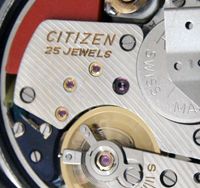
The case back tells us this is powered by the 7804A electro-mechanical movement, which runs at 36,000 beats per hour and was one of the later generation Cosmotrons. It was made in February 1974:

JaysCosmotronBackThe back is secured by a screw-in ring, and has a locating lug (see between the top lugs) which means the back is always in this position.

At first Jay found there was a problem, as the old battery had leaked slightly. But he was able to clean it out and a new battery saw it fire up. Great news after a long period of non-use 🙂

However, Jay then found it would not run consistently, sometimes stopping, sometimes running twice as fast as it should.  Jay is a resourceful guy though, and after consulting the reference information and diagrams on my Cosmotron page he was able to effect a repair – namely re-soldering a capacitor connection, and the watch is now running just fine. I must say that I was very pleased that my blog helped him solve the problem 🙂

Thank you Jay for letting me do a post about your watch – you have a technically interesting piece in very good condition, but more importantly you have a very nice heirloom through which you can remember your father-in-law. Wear it in good health.

Posted in Vintage Watches | Tagged , , , | 6 Comments

8110A Restoration Page Update

I’ve just added Parts 2 & 3 of Brian’s ‘Speedy’ restoration to the page: https://sweep-hand.org/brians-8110a-restoration-the-speedy-67-9313/

These take a close look at the case and dial, before we have a look at the movement itself in the next instalment.

If you aren’t already a follower of the blog, please sign up so you get an email alert each time there’s an update 🙂

Posted in Vintage Watches | Leave a comment

8110A Restoration Page Published

The page featuring Part 1 of Brian’s restoration of a Citizen 8110A ‘Speedy’ chronograph is now available 🙂  https://sweep-hand.org/brians-8110a-restoration-the-speedy-67-9313/

I hope you will follow the page as it progresses – I’ll post an update on the Home page too as each part is added so blog followers will get an email alert.

If you are interested and intrigued about the innermost workings of Citizen’s fine 1970s chronographs, then I’m sure you’ll find Brian’s page a great place to visit.


Posted in Vintage Watches | Tagged , , , , | Leave a comment

If You Like Citizen’s Vintage Chronographs….

…then I hope you will be interested in a new page I’ll be publishing this weekend. I’m no watchmaker, so my understanding of the inner workings of any watch is limited – chronographs are even more mysterious! However, as I trailed a few weeks ago, I am very happy that the work of a master watchmaker in the USA will now be featured here 🙂  We will be able to see how he restores Citizen’s  superb 8110 chronograph watch – and he can do wonders with what might otherwise be regarded as ‘no-hopers’.

In the meantime, here’s one that hasn’t needed restoration:


Posted in Vintage Watches | Tagged , , | 12 Comments

It’s 2014….

Posted in Vintage Watches | 2 Comments

It’s That Time of Year…..

Posted in Vintage Watches | 3 Comments

This Week’s Featured Watch #56 – the X8 Titanium Chronometer

This final Featured Watch of 2013 is something of a rarity – ‘rare’ is a much over-used term when it comes to vintage watch descriptions, but I’m confident that this one qualifies. The X8 Chronometer in a titanium case was produced only in 1970 and less than 2000 were produced, or sold. As Citizen themselves say (with apologies for the quirky on-line translation): Sales in short 2,000 less than production period, it is rare model with no opportunity to see quite now’.

The movement in this is the second generation X8 / Cosmotron ‘0820’, an electro-mechanical calibre with 19 jewels produced only for a couple of years from 1970 to 1972. The chronometer version, officially certified by the Japan Chronometer Association, appeared in just two models as far as I know.

Although the other model is itself seldom seen, this blue dialled one, given such a small production number, is particularly scarce. I have seen just one other for sale, on Yahoo Japan. However, it is made all the more special by the fact that it was a world first! It was the first watch to be made with a pure titanium case – Citizen describe it as being 99.6% titanium:

The case is unpolished, so is grey, and over the years the edges have been somewhat polished by use (giving it quite a nice look in my opinion). This model originally came on a plain black leather strap, so I’ve used a stitched leather strap for now, whilst I look for one that is closer to the original type. The case back is unique, in that the virtues of titanium are emphasised by the use of ‘scratch proof’:

From the serial number the production date is May 1970, whilst Citizen say it was first sold in September of that year.  ‘T. N.’ is used for the case material code – titanium was used for the case, bezel and crown:

Unusually, and not something I’ve seen in an X8/Cosmotron before, there is an inner back protecting the movement:

Under the cover is the 0820 movement, running at 21,600 beats per hour:

A closer look shows the unique movement number – and for those of you knowledgeable about batteries, I’ve now changed the alkaline one in the pic for a silver oxide cell:

The movement is running well, and keeping good time. With the crown pulled out (see second photo above) the electrical connection is broken so the watch is stopped when the time is set.

Other than solid gold models, this was the most expensive of Citizen’s range in 1970 – at JPY45,000 it was a fair bit more than the Chrono Masters and Leopard Chronometers. It was JPY10,000 more than it’s stainless steel sibling:

I don’t know why Citizen didn’t produce more of this model – Citizen make reference to the Apollo 11 moon landing, suggesting that it was a special edition to recognise that and the use of new materials like titanium in the space programme. Maybe machining of the material was not easy at first, even though it is now commonly seen for watch cases and bracelets. Also, the future of electro-mechanical models was clearly doomed at that time by the development of quartz technology, which quickly became Citizen’s priority in the 1970s.

An interesting piece of watch making history, this global first for Citizen is a nice way to round off 2013’s Featured Watches.

Posted in Vintage Watches | Tagged , , , , , | 7 Comments

A Little Trailer for the Next Featured Watch…..

The next Featured Watch will be the final one of 2013 – and I thought it would be fitting that it’s a rather special one,  that has just joined the collection. Here’s a little preview:

Posted in Vintage Watches | Leave a comment

Should the Citizen 8110A and 8100A Chronographs Be Left Running?

This question has been asked many times before, and the advice is that the chronograph mechanism should be left running to minimise wear. The same applies to the Seiko 6138 and 6139 vintage chronographs. This advice relates to the design of the mechanism and the use of a ‘vertical clutch’  – I understand that running the chronograph locks the clutch in position so there is no slippage. However, I’m obliged to Adrian Licu who has provided more information via his comments on the Automatic Chronographs page after he did some research on this issue. Although the advice to run the chronograph stands, it is also recommended that the watch is sometimes run with the chronograph stopped in order to avoid the clutch parts seizing together.  Here is the key part of the information Adrian kindly included in his comments. This advice was given about the Seiko chronographs, by Al Archer a Canadian watch maker:

……when the chronograph is turned off, the two parts of the chronograph runner have friction between them, since the large wheel must turn for the movement to run, and the chronograph hand does not move. Running the chronograph eliminates the friction between those 2 parts, but adds other loads such as the friction between the 2 ends of the shaft that the chronograph hand is attached to (one end in a jewel, the other in the tube of the center wheel). Also, there is the added load of the minute counter ticking over. Not sure I would say off or on has the most load – I would have to have the watch on the timing machine and measure the balance amplitude in both cases to confirm if one has more load (and lower balance amplitude) than the other.

But one thing you need to do with these is to run them with the chronograph off at least every so often. This will help prevent the chronograph runner parts from seizing together.’

I’ve amended the Chronographs page to include this advice.


Posted in Vintage Watches | Tagged , , , | 14 Comments

This Week’s Featured Watch #55 – the Jet Rookie

In the early 1960s Citizen used their ‘jet’ movement in their line of automatic watches. Featuring a circular geared rotor, the Jets have an unmistakable design once the case back is removed (see this page for more information: https://sweep-hand.org/the-jet-automatic/.

Most of the Jet automatics can also be hand wound, but a few models don’ t have this feature, notably the ‘Rookie’.  First produced in 1962, the Rookies were made with the plain dialled 03 movement or the 113 movement with date complication. Both movements had either 17 or 19 jewels. The 03 versions have small recessed crowns since they were not needed for winding, whilst the 113 have larger crowns to help with date setting. My example is one of these, with 19 jewels:

The back shows the model name and the older style model number:

This one appears to be on its original leather strap, which is no longer in wearable condition, but it’s interesting to see – typical for its day, it tapers strongly to the buckle end:

Also present is the original tag, showing the retail price in the early 1960s:

No movement shot since I don’t want to risk damage!

Posted in Vintage Watches | Tagged , , , | 3 Comments