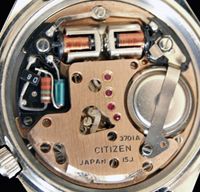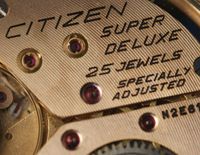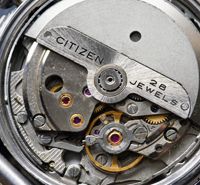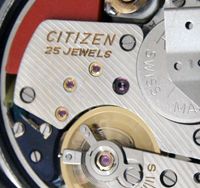
The humble ‘Homer’ was Citizen’s workhorse hand wind movement for many years. First produced in 1960 I believe it was produced right through to 1980 or so, not only in Homer badged models but in others as well – notably the ‘Newmaster’. It was also used in some Rhythm Time models. The Rhythm Time company was affiliated to Citizen in the 1950s and produced entry level mechanical watches, often in smaller sizes for youngsters.
This post is about the first and simplest Homer model, which used the 0200/0201 movement. Other Homers were made with date and day windows, but they are for another day…..
When first launched the Homer was most commonly produced in gold plated cases, which were more popular in that era. And despite their humble place in the quality hierarchy early models often featured textured and patterned dials, whilst some had hexagonal and square cases. Hopefully I’ll show more of them when I do a page / article on the range.
In the early 1960s there were also a few Homer variants – the ‘Guppy’, the ‘Special’ and, featuring red, yellow or green dials – the ‘Pansy’.
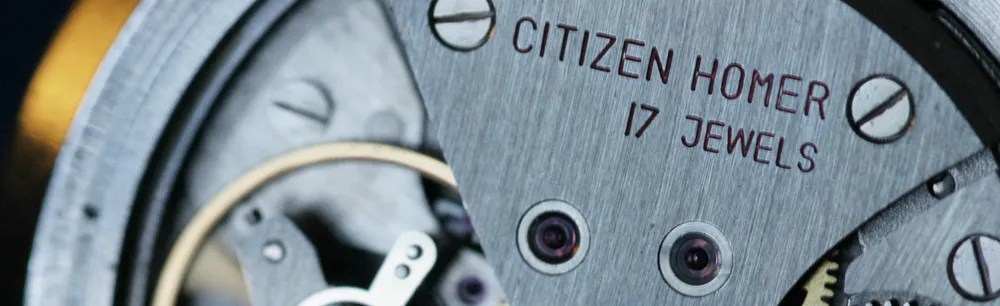
The 0200/01 movement was initially made with 17, 19 or 21 jewels, later it was also seen with 7 jewels as costs were kept down for the younger market. Here’s a shot of the 17 jewel variant:

Here’s my early Homer – this one carries the Minolta company logo on the dial, which has some spotting which is all the more apparent when photographed!:

The dial carries the ‘Parashock’ and ‘Phynox’ text typical of earlier models, has a nicely finished chapter ring around a brushed centre and engraved hour markers:

Made in April 1963, this special edition for the Minolta company has nice low production number of 13:

And now let’s fast forward 10 years…..this 21 jeweled example is from May 1973, and the Homer logo has been dropped:


The stylised crown marker at 12 o’clock is also seen on the ‘Newmaster’ models, whilst the case back is now screwed on rather than a snap on type.
Finally, here’s an example of the Rhythm Time versions – same movement but in a smaller case, suitable for a teenager:

The case is chrome plated (‘CCP’), reflecting that this was an inexpensive watch:

The movement in this is clearly lower quality to keep costs down, with just 7 jewels and crudely stamped marks. Despite that this one has been serviced by the look of it:

Why the name ‘Homer’? I don’t really know the answer to that, but the Greek meaning of it I believe is to do with ‘security’ or a ‘pledge’ – makes sense that this was chosen since this movement has proved to be very sound and reliable.