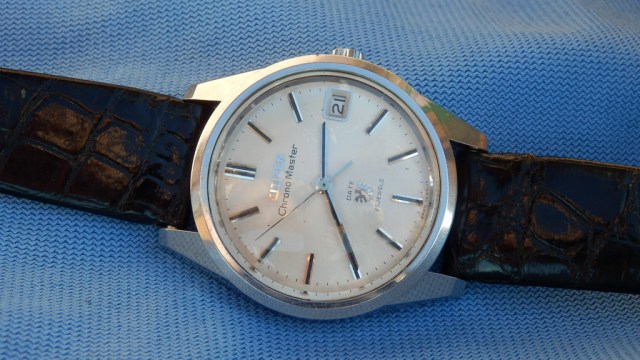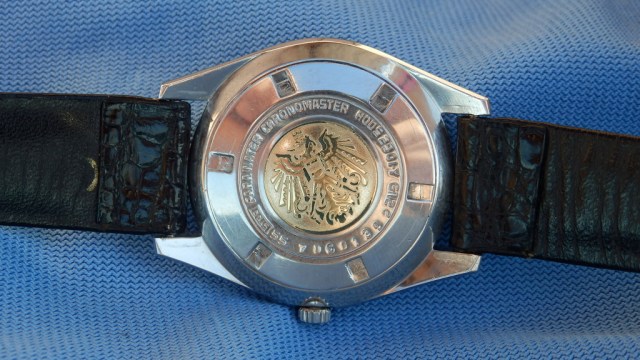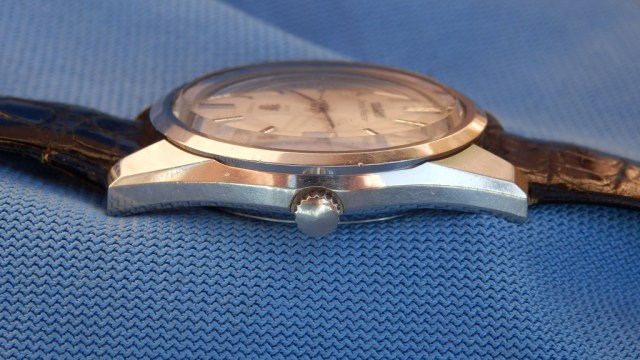
Leopard (Highness) Chronometer Original Faceted Glass

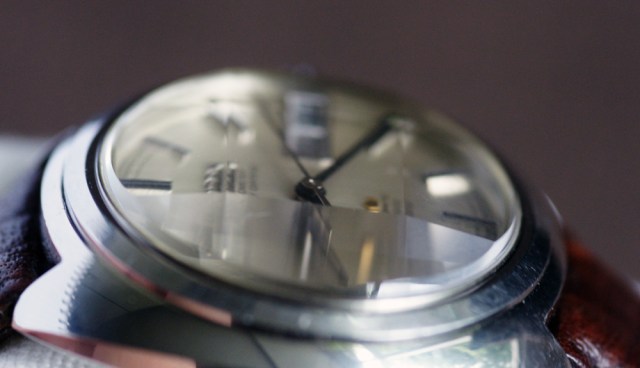
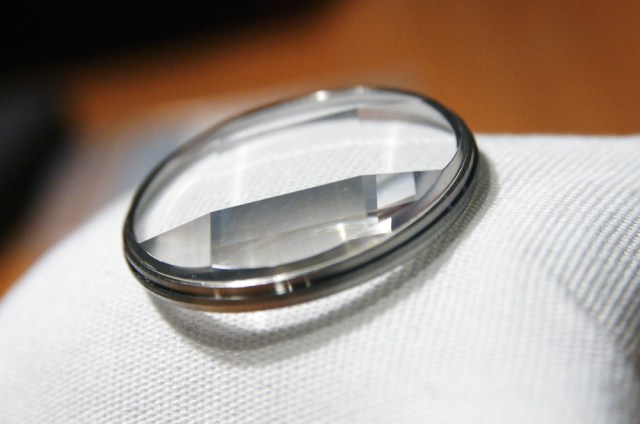
There’ll be a full write-up on the work Brian Leiser did to repair my Leopard high-beat Chronometer, so for now here’s a post about the original crystal I managed to source from Japan – the only one I’ve seen in fact! The glass was listed for a different case number than mine, but I knew it uses the same faceted crystal. I received this a month or two ago, but it was only this week that I dared to try and fit it (replacing an original flat glass that Brian fitted):

SONY DSC

A rather beautiful, and rare, nine facet glass. Not something to be damaged by an enthusiastic but clumsy owner! However, I managed to do it – I didn’t breathe whilst I pressed the bezel into place 🙂 :

SONY DSC

SONY DSC

SONY DSC

SONY DSC

I was so keen to get some photos done I left a little of the clear tape on the bezel that I used to hold the glass in the correct position!

You may have noticed that this post has ‘Highness’ in the title. I discovered that what we have called the ‘Leopard Chronometer’ was in fact the ‘Leopard Highness’. Later models had the Highness name on the dial, or ‘CH’, and the applied gold logo was dropped as was the case back medallion. I hadn’t realised this until recently when I translated the Japanese text in the 1971 catalog. See the highlighted part in this scan, which translates as ‘Leopard Highness’:

SONY DSC

I had thought that the Highness simply replaced the Chronometer, when in reality the latter had been the first and original version of the Highness, but with higher production values!
Posted in Vintage Watches | Tagged , , , | 13 Comments

More About the 777 Autodater…

Although in good condition, this example was not running  when I bought it, except for a few seconds when shaken or wound. Otherwise it seemed to be winding properly by hand and the sound from the rotor seemed ok. Time setting and date change were also fine. I had thought that I could maybe do a movement swap if necessary, so it was time to take a look inside.

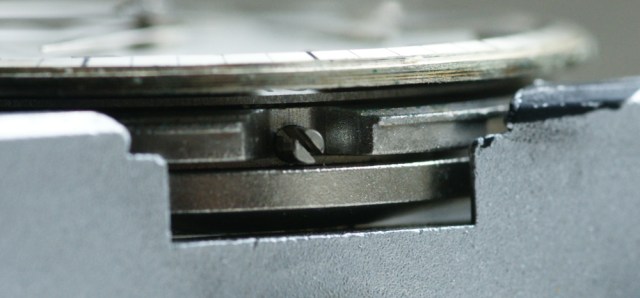
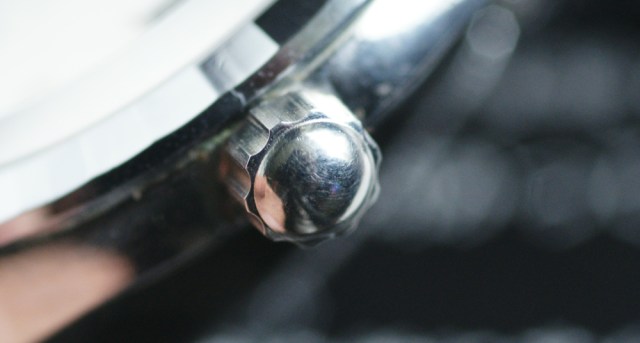
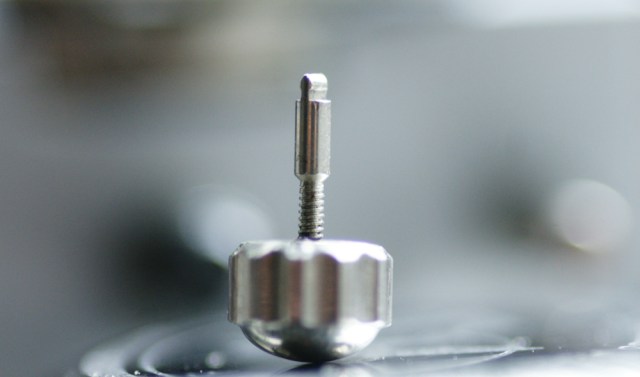
The case is a one piece design, so access to the movement is from the front. The crown is a two piece design, and it has to be pulled quite hard to remove it. This has to be done of course to allow the movement to drop out of the case once the crystal is off  – it’s a little disconcerting since a fair bit of force is needed. But once off the way the two parts connect is clear:

SONY DSC

The crown and outer stem is pushed into this slot:

SONY DSC

After carefully prising off the bezel, I found the crystal was not keen to come out. I checked with Brian Leiser first to see if any special tools were needed, but he advised (thanks Brian 🙂 ) that no, but the crystal is likely to be tight to the gasket after possibly years of  no attention. Using a suction cup didn’t help, so I very carefully and gently levered the crystal up (using a loupe to watch closely what I was doing), trying to engage with the metal ring on the lower part of the glass rather then the glass itself. I could see it was moving a little so after working round the glass and gently easing it, I found the suction cup did lift it off, without any damage done…phew!

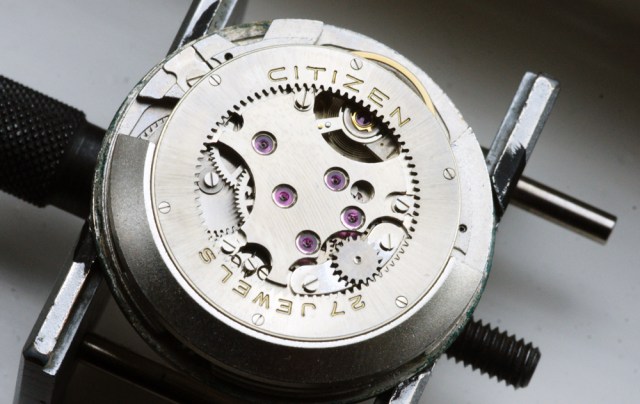
Interestingly I found the watch immediately started to run once the glass was off. And when I replaced the glass, it did not run. The solution was simple – a slight re-shaping of the second hand, bending the tip down a little since it had been touching the underside of the crystal. So no change of movement or repair needed 🙂  And it’s a nice movement, the 1121 Jet first produced in 1962:

SONY DSC

The watch is now running flawlessly, and keeping very good time. I wonder how long it has had the problem with the sweep hand – the difficulty in removing the glass suggests it hasn’t been opened up for quite some time. It was an easy enough adjustment to make – as it had to be for me to sort it out!  – so I’m surprised it hadn’t gone to a watchmaker for repair.

I’m still trying to figure out the ‘DMC’ logo on the dial – I have seen this on a diver but with a very plain font used. I have found that there is a DMC machine tool company in South Korea – founded in 1944 it makes machinery for milling etc. Citizen opened a factory in Korea in the early 1970s so I wonder if there is any link? Nor can I explain the 777 logo – maybe just a model name referencing Citizen’s later use of the Autodater 7 moniker. ‘555’ models were also made including one with the same 27 jewel movement, and the use of 555 is also a mystery!

SONY DSC

Posted in Vintage Watches | Tagged , , , | 10 Comments

This Week’s Featured Watch #76 – Jet Autodater ‘777’

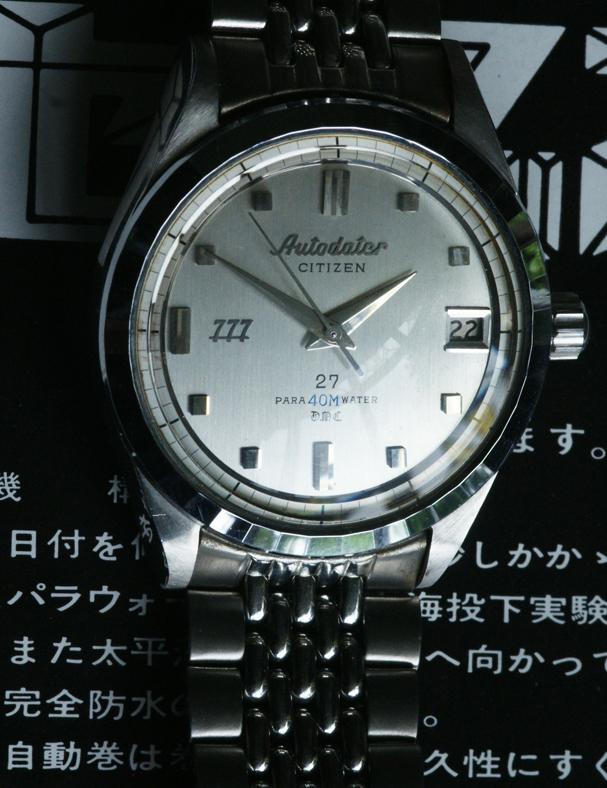
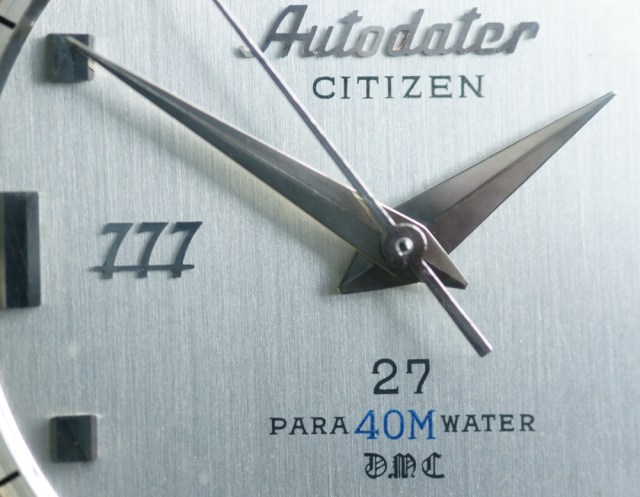
Citizen sometimes produced special editions, and one of the rarer ones is this week’s featured model – it’s an ‘Autodater’ from the early to mid-1960s with a 27 jewel version of the 1121 date only Jet movement first produced in 1962. This model is designated as a ‘777’ and this logo is applied to the dial. One nice feature is that the ‘Autodater’ logo is applied, rather than ‘Citizen’ which is printed beneath. I don’t think I’ve seen that on any other model.

SONY DSC

The watch is rated at 40 metres, and is also marked ‘DMC’ in a fancy gothic font – I have seen ‘DMC’ on at least one other model, but I’ve yet to determine the meaning…

SONY DSC

The bezel is gently fluted, whilst the case is a one piece design with a thick mineral crystal and large crown:

SONY DSC

As with some other special editions, which were probably made for export (i.e. marked ‘waterproof’) the case back has a unique design, unfortunately with no production date to go with the case / model number of ADOS81301:

SONY DSC

All in all this is an interesting and rare model, with a nicely etched case back and unique dial. Now I just need to find out what the significance of ‘DMC’ is – maybe a company that commissioned the watch?

SONY DSC

Posted in Vintage Watches | Tagged , , , | 4 Comments

Citizen’s Special Cosmotron was a World First

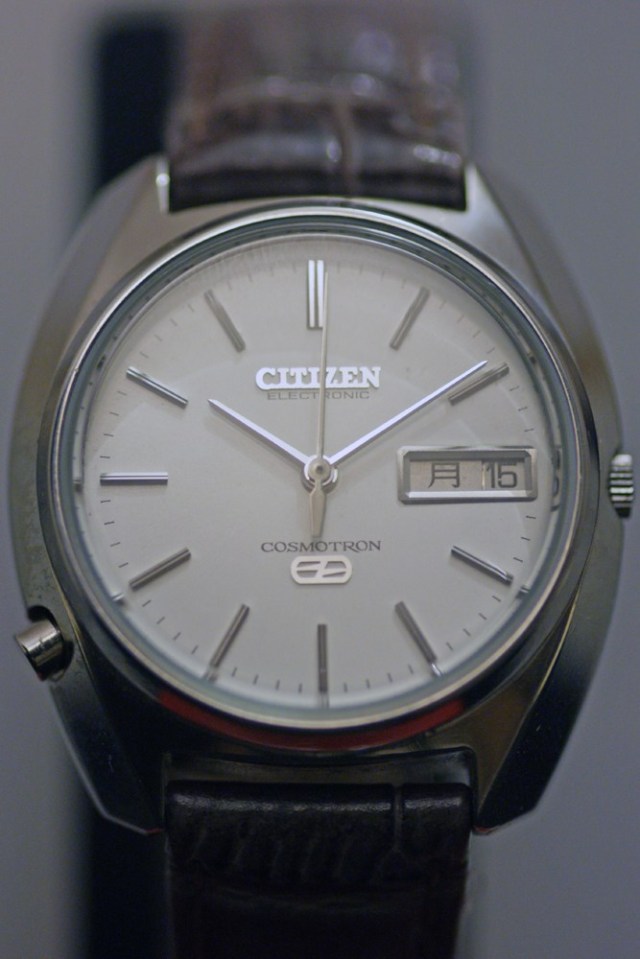
Citizen was the first Japanese manufacturer to sell an electric watch, in 1966, using a battery and printed circuit instead of a mainspring, powering a relatively conventional hairspring. As the technology was developed, they also produced one version in a titanium case – a world first – as a limited edition, in 1970. However, there was also one other ‘world first’ in the Cosmotron line-up, this time a special feature of the 7803 movement. It was known as ‘Just Setting’ and allows the watch to be accurately synchronised to a radio or TV time signal. Although the watch has a conventional ‘second setting’ function, the additional unique element of this movement is that the hour and minute hands as well as the second hand can be set if within ± 3 minutes of the 12 o’clock marker, using a button at the 8 o’clock position. Here are Citizen’s original instructions for this function (with thanks to whoever uploaded this to the internet):

7803specialjusatsettinginstruction_zpspj1jfsnp

And here’s a video of ‘Just Setting’ in action:

http://s282.beta.photobucket.com/user/Sweephand/media/Cosmotron%20Page/7803Hacking.mp4.html

Known as the Cosmotron Special, these are very nice watches. Running at 36,000 beats per hour they are an accurate and unusual timepiece, with that rather unique feature

SONY DSC

Posted in Vintage Watches | 2 Comments

An Interesting Diamond Flake Restoration

Back in April a great guy called Panos visited the blog with a question about a gold plated Diamond Flake which he was thinking of buying. Although in running order it had a problem –  the 0700 movement had a broken set lever. Panos had searched long and hard for a replacement with no luck, but it so happened that I had a spare lever.  Although it was a little corroded it was in one piece and I was happy to help, so sent Panos the part in the hope that his watchmaker (from whom he’d bought the watch) could use it and restore the movement to full working order. Panos has now kindly got back to me to show me the outcome, which I thought I would share here 🙂

The restoration is all the more interesting because the wear and damage to the original gold plated case was severe, so it has been re-plated. I don’t know if many people go down this route, and my only experience of it (and seeing some examples on the internet) left me thinking the new finish was just too bright and shiny! However, on Panos’ watch I think it looks pretty darn good, and the dial is excellent so it looks to be a nicely unified piece. See for yourself by visiting the watchmaker’s blog, where there are also some very nice pics of the movement in various states of disassembly:

http://watchguy.co.uk/service-citizen-diamond-flake-calibre-0-700/

Thanks to Panos for agreeing to me posting about his watch. It’s great to see a Diamond Flake up and running again in all its glory 🙂

Posted in Vintage Watches | 5 Comments

Never Give Up Hope! – Part 2

They say that ‘patience is a virtue’ – well that’s certainly true when it comes to looking for parts for vintage Citizens! A while ago I acquired a  Leopard Chronometer which was not without its problems. It went off to our renowned master watchmaker Brian Leiser in the USA, and he did a splendid job with it. A new crystal was needed, since the original faceted glass was deeply scratched, and although Brian managed to source an original replacement it was the flat version.  So the search was on for the faceted type, a part I’d not seen anywhere for sale….but….as they say ‘hope springs eternal’……
This has just arrived 🙂

SONY DSC


Posted in Vintage Watches | 6 Comments

Never Give Up Hope!

Back in mid-December 2015 I was sent some very, very hard to find crystals from the USA. They were the last I could find anywhere. And they went to Canada….so Canada sent them back to the USA, bearing in mind that they were supposed to come to the UK. They bounced in and out of a depot in Chicago, and then….nothing! Despite being chased up several times by the sender, the USPS could do nothing to help, so it seemed that they had gone AWOL, and we gave up on them.

Then, completely out of the blue, they were delivered through my letter box last week, a mere 4 and a half months after posting!!  I have no idea where the package has been but someone, somewhere, managed to get it on the right plane 🙂  I was totally amazed to receive the crystals after all this time, but it does go to show that there is always a chance of a good outcome, even when things seem to have gone irretrievably wrong.

Posted in Vintage Watches | 2 Comments

A Word About Chrono Master Crowns

In my article on the Chrono Master line, I included this note about crowns:

‘A quick note about crowns – I can’t be absolutely definitive about crowns for all the Chrono Masters, since many of my reference pictures are straight ahead and only show the profile of the crown. I would think all crowns should be signed with the ‘C’ mark, rather than ‘CTZ’ – but otherwise please use the images in this article as a guide.’

Recently Max from Italy contacted me about his 1870 model (hand winding with date), from 1967 when Chrono Masters were first launched. Max noticed that the crown is plain, not signed, and he had found one or two other examples, from the same year with the same unmarked crown.  I have also found a couple more like this, suggesting that an unsigned crown, on this model at least, may be an original fitting. So I will update the Chrono Master article to include this information, with many thanks to Max 🙂

Max has also kindly allowed me to use photos of his watch, and as you can see it looks like a very ‘honest’ example, and, remarkably, still fitted to an original strap:

OLYMPUS DIGITAL CAMERA

OLYMPUS DIGITAL CAMERA

OLYMPUS DIGITAL CAMERA

OLYMPUS DIGITAL CAMERA

OLYMPUS DIGITAL CAMERA


Posted in Vintage Watches | Leave a comment

My ‘New’ 3 Star Auto Day-Date

In 1953 the Rhythm watch and clock company became an affiliate of Citizen, and although they continued to make watches using Citizen movements, their primary business was making clocks.  I thought it would be good to have this part of Citizen’s heritage represented in my collection (especially after a drop or two of wine!) so this week a large box arrived from Japan…..

SONY DSC

This is a wall clock with a thirty day mechanism, striking on the hour and half hour, and featuring date and day wheels. Although I’ve seen few Rhythm clocks like this for sale, similar Seiko, some Aichi Tokei Denki and one two other makes can be found, most of which are in brown wood cases with patterned glass in front of the pendulum. So I was pleased that my Rhythm example is in black wood with plain glass, and although clearly vintage, it has a design that goes well with modern décor, at least in my opinion anyway 😉  As far as I know it was made in the mid to late 1960s.

I’ve mounted the old printed paper instructions for setting the day and date on a piece of card, which you can see in the pendulum box. The method is the same as with a watch, so the day is set first, then the date can be moved forward. The date is reset at the end of each month (it will move to 32 if not reset). The right winder is for the clock spring, and the left for the striking spring. Hopefully it needs winding just once a month, and the power window is neat feature.

The red button is a marker for where the pendulum should hang when centred, and there a couple of adjusters in the lower part of the case, which can be turned to move the case away from the wall to help get it vertical. The strike gives a pleasant and not too loud ring, so it can be left running and striking without disturbing the rest of the house.

Historically this type of wall clock has not been common in the UK, and more recent (non-Japanese) versions have a poor reputation with clock repairers who regard them as being of poor quality, using inferior metals etc. I think it’s important not to tar Rhythm and other Japanese makers with the same brush, particularly for their 1960s/70s offerings where I have only found good reports about them and their reliability and accuracy.

Although it is early days, my Rhythm ‘Three Star’ is keeping excellent time, without any regulation on my part. Not bad for $29 (US) (+ a lot of shipping!)

Posted in Vintage Watches | Leave a comment

This Week’s Featured Watch #75 – 4-722132

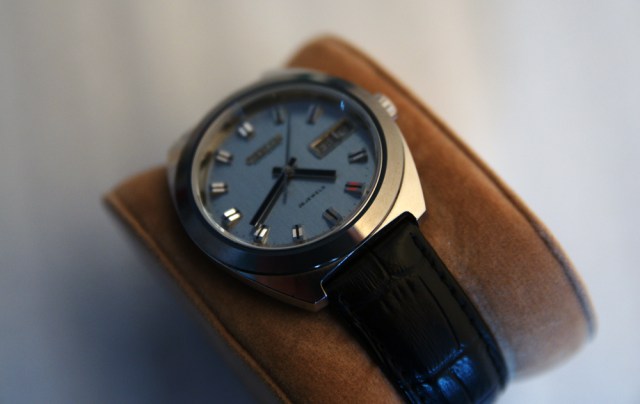
This week’s watch might be called a Leopard that has lost its spots 🙂  I came across this model for the first time recently, case number 4-722132, with 26 jewels, from August 1971:

SONY DSC

Although the 7200 movement with 26 jewels runs at 21,600 beats per hour (bph), the 7210 variant runs at 28,800 bph and is one of the Leopard family. I noticed that this example had a fine adjuster on the balance, a clear sign of a high beat movement. However, with no Leopard, ‘Superbeat’ or 28,800 logo  on the dial I was intrigued – in fact for another reason which I’ll come to shortly I was doubly intrigued. On arrival I quickly found 7210 stamped on the movement, so confirmed it’s the high beat version:

SONY DSC

SONY DSC

Before buying I had of course wondered if it may be a so-called ‘franken’ watch, i.e using parts from different models. But I was able to find a couple of other examples of this watch, both with the exact same markings, and also without any of the usual Leopard’s markings. I could also see that the same dial code was evident, and one that is appropriate for a 72 model – 6-724850. So I am happy that this is a genuine model, and the first ‘Leopard’ that I have found without its ‘spots’.

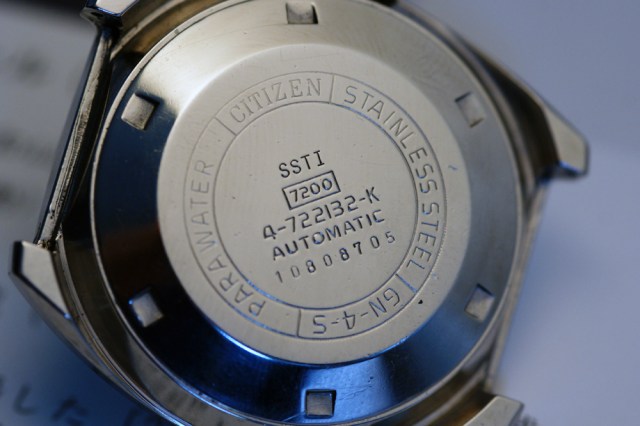
The other feature that intrigued me is the bezel material, indicated by the case back code:

SONY DSC

I have seen ‘BLTI’ before, i.e on a black coated case, but not ‘SSTI’. See my example here: https://sweep-hand.org/2011/10/19/this-weeks-featured-watch-15-6501-with-tungsten-bezel/ 

I’ve been working on Citizen’s case material codes lately, and although these ‘TI’ codes are unfortunately notable by their absence, Citizen used Titanium Carbide (TiC) and Titanium Nitride (TiN) so could this bezel be TiC (as opposed to TiN which is gold coloured)?  But it now gets a bit more complicated! On other, slightly later models, Citizen used UHA (TiC) and UHAG (TiN) for their carbide cases and bezels, whilst I’ve seen some descriptions of TI bezels as tungsten carbide, hence my description of the BLTI model as tungsten. My titanium (not carbide) cased X8 Chronometer is marked TN….It’s possible therefore that Citizen used tungsten carbide at first, using TI as the material code (for a reason that is somewhat lost on me!)  and then adopted UHA for their Titanium Carbide models. I noticed on another example of this watch that the bezel was chipped on one side. Although tungsten carbide is very hard, it is relatively brittle, so that damage lends some additional credibility to it being that material, perhaps replaced later by titanium carbide as a better option. Any thoughts/more information is very welcome!!

Whatever the exact material of the bezel, from a cosmetic point of view it has an attractive grey appearance and certainly shows little or no signs of wear:

SONY DSC

All in all this is an interesting watch, with a good quality movement and an unusual case material and bezel combination.

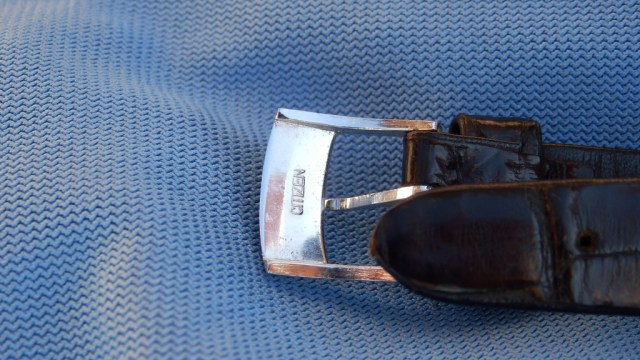
SONY DSC

Posted in Vintage Watches | Tagged , , | 7 Comments