New Watch Forum – Link Added to ‘Wrist Sushi’

If you are interested in Japanese watches, then there’s a new forum just for you 🙂  Called the Wrist Sushi forum and I highly recommend it . It’s now in my Blogroll, whilst here’s the link to save a click!:

http://wristsushi.proboards.com/

Posted in Vintage Watches | Tagged | Leave a comment

This Week’s Featured Watch #53 – the College Alarm

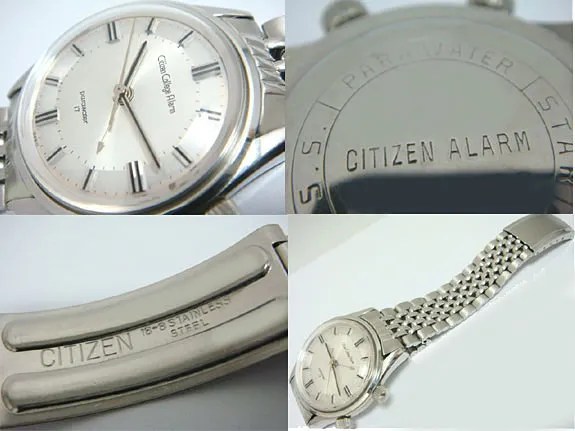
This week I’m featuring a ‘guest’ watch rather than one from my own collection. I am grateful to Matt Diehl for contacting me about it and then sending photos, along with permission to use them here.  Full credit goes to Matt for the first three images in this post.

This is an interesting and relatively rare watch, which is why I wanted to feature it here. It is one of Citizen’s alarms, known as the ‘College Alarm’. It has what looks to be a unique font for the printing on the dial:

Matt’s example is in excellent condition, having been used only a few times and then stored, so it is a very nice original piece. The movement used in this model is the 9810 with 17 jewels. This movement was first produced by Citizen in 1958 using a Swiss hand winding design, and there was also a 21 jewel version. The College models feature large winding crowns and as far as I know only use the 17 jewel movement:

Here’s the case  back, showing production in 1966 (the style of the back has the ‘transitional’ format as I’ve call it – see the case backs page: (https://sweep-hand.org/vintage-citizen-case-backs/) :

Seeing this back and production date prompted a little more research on my part, which confirmed that Citizen continued to use the 98xx movement alongside the later 31xx models, which has a date window and is only found with 21 jewels (first produced in 1964). The College was made at least until 1971 – here’s one in the catalog  from that year:

The College Alarm was the least expensive in the range of alarm watches, I guess with its name and price it was targeted at younger people.

Finally, here’s another example, seen for sale on Yahoo Japan – it looks like the model in the 1971 catalog (credit to the seller for the images):

Thanks again to Matt for permission to use his photos 🙂   This has allowed us to view a seldom seen model.

Posted in Vintage Watches | Tagged , | 11 Comments

Case Back Page Published

The page on case backs is now published – https://sweep-hand.org/vintage-citizen-case-backs/ . In fact it’s the first of two, since this one covers the basic types. I’ll be doing a second page, on ‘special’ case backs soon….

This one also includes a section on dating your Citizen watch.

Posted in Vintage Watches | Tagged , , , | Leave a comment

Case Back Page

I’ve now been able to make some progress in getting a page ready on Citizen’s vintage case backs. I should be able to publish that soon – it will also include guidance on determining the production date of a watch. Although this is available at the end of the Movement Table, also having it on a page here will make it a little more accessible.

The page should be published in the next day or two…..

Posted in Vintage Watches | Leave a comment

This Week’s Featured Watch #52 – Homer Pocket Watch, 21 Jewels

Something a bit different today – Citizen started with pocket watches back in the 1920s, and continued to produce them whilst fashion changed and the wristwatch became the norm. I’d like to get hold of one of the first pocket watch models, but for now I am very happy with this Homer model from the late 1960s:

This one uses the very reliable 02 Homer movement – Citizen also used the 18 movement with date window in some pocket watches. Personally I prefer the simple looks of the plain dial, and the black hands on this one are very nice indeed (with credit to seller for pic):

The chain on this is for use with a belt (more traditional chains are used with waist coats or ‘vests’) and the watch is kept in the small pocket usually found above the right pocket:

The watch is in very nice condition, and I haven’t tried to open the back for fear of damaging it, and it is neatly inscribed:

I understand the inscription relates to a safety award from the Fujita company.

Will make a nice change to wear a pocket watch 🙂

Posted in Vintage Watches | Tagged , , | 1 Comment

Over 45 years old, but super accurate….Update

After nearly three weeks I have adjusted the time on this Crystal Date this morning – it was about 30 to 40 seconds fast. I reckon therefore that the watch is running at most at about +2 seconds a day. Nice 🙂

Posted in Vintage Watches | 2 Comments

Over 45 years old, but super accurate….

I’ve been wearing a 1967 Crystal Date for the past couple of weeks – this is the date only version of the Crystal Seven, and is one of the 52 Movement Family members.  This 17 jewel model has the 5401 movement in it (54 = date version, 52 = date and day version):

I really like the lumed hand set on this model, especially the elegantly slender minute hand. But what is really impressive is its time-keeping performance – I haven’t had to adjust it for two weeks, which is quite remarkable in my opinion for a watch of this age and with no recent service / regulation. I suspect many modern high end mechanical watches would do no better than this I suspect.

For a bit more information see here: https://sweep-hand.org/2012/05/10/this-weeks-featured-watch-32-the-crystal-date-17j/

Posted in Vintage Watches | Tagged , | 6 Comments

This Week’s Featured Watch #51 – the Diamond Flake

In 1962 Citizen introduced the beautifully named Diamond Flake based on the 0700 movement. Why this name? well a diamond flake would be thin, and at the time the 0700 movement was the thinnest Japanese design, measuring just 2.75mm deep – beating the Seiko Gold Feather by 0.2mm. I say ‘beating’ because there was something of a race to produce the thinnest movements, following the fashion for ever slimmer dress watches.

Here’s an ad from the time:

The movement was made with either 25 or 31 jewels, and later a date version was made (2700 movement, 25 jewels). My example has the 25 jewels calibre:

The logo at the 12 0’clock position is unique to the Diamond Flake, and the narrow hands on this model emphasise the slender overall design:

The thin movement allows a slim case:

This is a hand winder of course, an automatic would have been necessarily thicker to accommodate the rotor and auto winding system. The gold finish of the movement indicates that this was a good quality model:

The case back, with production in September 1963:

Some models were depth rated to 40 meters, but these were essentially dress watches, wearing light and comfortable under the cuff.

Posted in Vintage Watches | Tagged , | 26 Comments

Citizen’s First Wrist Watch Movement

Following the last Featured Watch which presented the Adorex 8000, with its high beat movement and innovative regulator, I thought I’d contrast that with a post about Citizen’s very first wrist watch movement – the type ‘F’.

Following the establishment of the Shokosha Watch Research Institute in 1918 the first watches produced in 1924 were pocket watches, which were, of course, the fashion at that time. After its pocket watches were called ‘Citizens’ by the mayor of Tokyo the company re-formed itself as the Citizen Watch Company in 1930. And a year later the first wrist watches were produced, using a Swiss design in the form of the type F:

This is a sub-second design, i.e. it has a small second hand above the 6 o’clock marker, and is a relatively simple and basic design, running at 5 beats per second (18,000 beats per hour):

The type F was produced into the 1950s, but the design was changed quite significantly during its production run – the 1950s design had much more angular top bridge, and with a variety of jewelling, see this example:

Typical of their day, these are small watches – my early model in the first two pictures is only 27mm wide. I don’t suppose that in 1931 the people making these would have thought that from these small beginnings Citizen would become the world’s largest watch manufacturer….

Posted in Vintage Watches | Tagged , | 1 Comment

This Week’s Featured Watch #50 – the Adorex (8000)

In the early 1970s Citizen were making a range of high quality automatic mechanical and electro-mechanical watches as their production development reached its peak, just before the introduction of mass produced quartz models transformed the landscape. An example of Citizen’s expertise and innovation is the ‘Adorex’ line – especially those models with the 25 jewel 8000/8001 movement (technically the 8000A/8001A, but I don’t believe any other variants were made).

The Adorex models used two movements, during only a short production run starting in 1974 – the 8000 and the 8050. But it is the 8000 movement that is of greatest interest, since it has a unique feature not seen in any other model before or since, as far as I know….

Firstly here’s my example, which has a sparkling white dial in an otherwise conventionally designed stainless steel case:

The 8000 movement was the first to use a rotor which wound in one direction, which became the standard design a year or so later in the ubiquitous 8200 movement – the movement number is clearly stamped on the back, with a production date of February 1974:

Here’s the movement, with the arrow on the rotor showing the winding direction – these are high-beat, running at 28,800 beats per hour:

But uni-directional winding is not the unique feature….you may have noticed that there is no conventional fine adjuster on the balance, but there is a lever which locates in a slot:

And this is the unique feature of the 8000 Adorex – since this lever, which allows fine adjustment of the hairspring, is connected to the crown. So this allows regulation of timing without opening up the watch – it is activated by pulling the crown out to a third step, beyond time setting position, as seen in this scan of the instructions:

Pulling the crown out to the regulation position is not easy, it takes some force, presumably to avoid accidental activation. Here’s a video of the feature in use, with the back removed to clearly show what happens:

http://s282.photobucket.com/user/Sweephand/media/Adorex/AdorexRegulator_zpse51f7a56.mp4.html

The design was probably not deemed to be too practical – the degree of movement for regulation is necessarily small, and not being able to see the gear as it is moved would make it difficult to use without removing the case back. So it’s an innovation that was only seen in this model and therefore short-lived – yet fascinating to see and now to have in the collection.

And remember, if you are looking to acquire one of these, it is only found on the 8000/8001 movement, whilst the 8050 Adorex’s have the conventional type of fine adjuster.

Posted in Vintage Watches | Tagged , , | 11 Comments