This Week’s Featured Watch #8 – the Crystal Seven, 27 jewels

In 1965 Citizen launched a major line of watches called the ‘Crystal Seven’. The name is derived from the type of glass used, the first time Citizen used ‘crystal’ glass – I’m not sure if this was sapphire or equated for example to Seiko’s ‘Hardlex’ mineral glass. The ‘Seven’  continued Citizen’s use of this title first seen a year earlier, in 1964, in both auto-dater and hand-winding models.

Using automatic movements (the 52xx series) with oscillating weights rather than the circular geared rotors as seen in earlier ‘Jets’, the new range was extensive in terms of both jeweling and models. It was Citizen’s main automatic line of watches at that time, and although production was not long-lived – there are no Crystal Sevens in the 1971 catalog – it was clearly successful, and is the most commonly seen vintage Citizen automatic watch in the on-line auctions.  No doubt as a result of this, an example of the Crystal Sevens proved to be my first vintage Citizen purchase, and since I was impressed with its quality it became a key influence in my collecting focus.

The model I acquired sits more or less in the middle of the line, having 27 jewels – the jeweling ranges from 21 to a whopping 43, Citizen’s highest jeweling of any of its watches. Original prices reflected the jewel count, starting at JPY9,800 (21j) to JPY19,500 (43j). Mine would have cost about JPY13,500 when it was made in 1968:

On it’s very comfortable ‘beads of rice’ bracelet, the watch features a blueish silver dial and has a good quality set of hands with black centres and a well finished chapter ring:

The back is marked with the Crystal Seven logo, and shows a production date of April 1968:

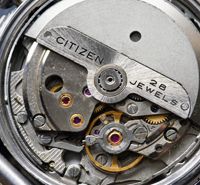
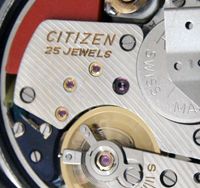
The movement runs at 18,000 beats per hour, and typically the rotor is signed and includes the jewel count:

Given the extensive model line-up, this won’t be the only Crystal Seven to feature here – which will also reflect the importance and popularity of this watch in its day – whilst a good example of this line is a great buy either for regular use or as a collection piece.

Posted in Vintage Watches | Tagged , | 7 Comments

This Week’s Featured Watch #7 – the Hi-Line

Following the success of the Deluxe model, launched in 1958, Citizen followed up with the Ace (see Featured Watch #5) and the Hi-Line in 1961. The Ace used the 92xx movements as first seen in the Deluxe.  However the Hi-Line used a new movement – the 0500, 0501 and 0502 – which was the same width but was slimmer at 3.25mm rather then 3.65mm.

The Hi-Line completed Citizen’s mid-range hand winding line-up at the start of the 1960’s, and came in 23, 25 and 27 jewel variants. Here’s my 23 jewel example, typically marked Parawater and Parashock, from December 1962:

The back has the trademark scrolling around the markings, which of course include the serial number which provides the production date:

Nice movement although like the Ace it isn’t marked as having ‘adjustments’ as is found on the Deluxe, and runs at18,000 beats per hour:

Based on original retail prices, the Hi-Line was the slightly more expensive of Citizen’s mid-range manual watches, and along with the Deluxe and Ace, offered a good quality and reliable watch.

Posted in Vintage Watches | Tagged , , | 3 Comments

It Came in a Box……

but that was when it was new! I’ve got four examples – moving back in time, the first is a rather plain box from 1974:

Fortunately the watch inside is not plain:

Next is a Seven Autodater box, from around 1964. In those days, they had an outer box:

The inner box is more interesting, with a very cool 3-d design:

Going back a year or two and here is a Jet Autodater box, again with an outer shell, I like the graphics on this one very much:

And the inner plastic box, with instruction card and marked with the ‘C’ logo:


Instructions show how to set the date:

Inside the inner box lid the gold coloured printing repeats what is found on the outer shell:

And the box is nicely lined in blue:

Finally, here’s a Super Deluxe box from the late 1950’s:

Boxes may sound boring, but for me they add to the collection and are evocative of the time they were produced.

Posted in Vintage Watches | 2 Comments

This Week’s Featured Watch #6 – the Challenge Golf

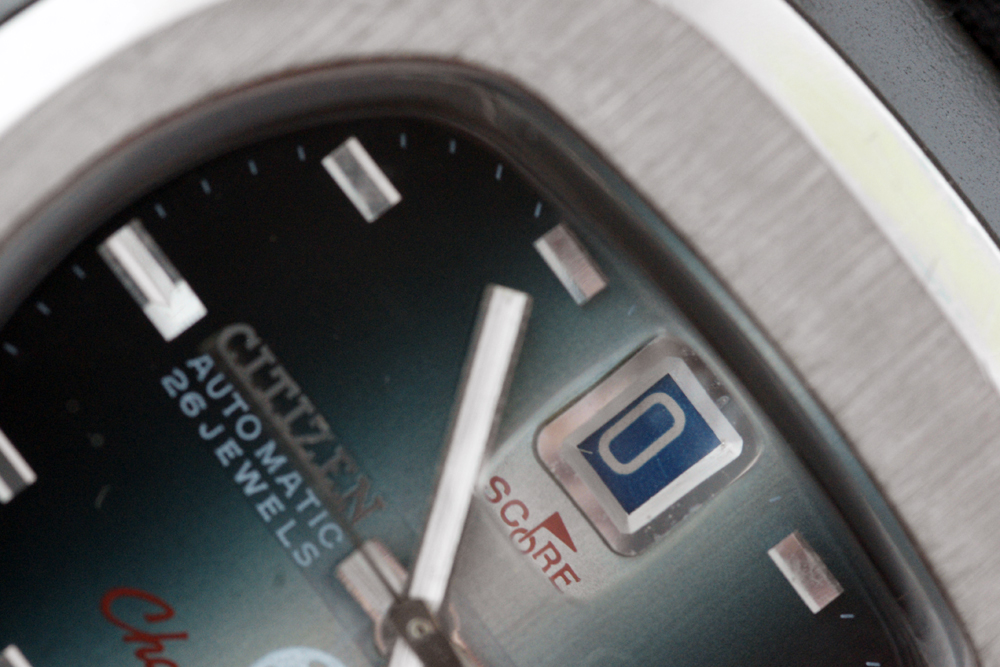
I’m playing in a golf competition tomorrow, and that made me think of one of my watches, a rather unusual model called the ‘Challenge Golf’. First produced in 1972 when golf was becoming enormously popular, Citizen came up with a novel feature in the form of a score counter. The 7760 movement is unique to this model, and is part of the Leopard family of movements. There were two case types, one with a round dial in stainless steel or gold plate, and one with a rectangular or ‘TV’ dial. They either had green or blue dials with black  PVD coated cases – here is my TV style mode, with wide brushed stainless steel  bezel:

The face features a small date window at 5 o’clock position, and more prominantly the score counter at 12 o’clock:

Unusually the signed crown is positioned at 8 o’clock. The movement is automatic, but can be hand wound and it ‘hacks’. The date is not quick set, so is set by winding back and forth between 12 and 9. The score counter is moved on by pressing the crown in (you can see in the first image that the crown sits slightly out to allow it to be depressed to move the counter):

The back is stamped conventionally with the movement and case numbers, and ‘BLS’ (black and stainless steel) case material code.  Serial number shows production in May 1973 – I suspect these models had only a short production run. Again you can see how the crown sits proud of the case in the normal running position :

Here’s the movement – 26 jewels and a fine adjuster indicate a high quality piece:

Finally, the rather neat logo:

Posted in Vintage Watches | Tagged , , | 2 Comments

This Week’s Featured Watch #5 – the Ace

Following the success of the Deluxe, launched in 1958, Citizen used the same movement but at a slightly lower grade (i.e. without the three adjustments) in 1961 with the launch of the ‘Ace’. Produced (as far as I can determine) until 1966, it used hand winding movements numbered 9210, 9230, 9231 and 9232 – the Deluxe movement was the 9200 – and was loaded with either 21 or 23 jewels. Here’s mine from October 1962, featuring a wide and fluted bezel, typically marked Parawater and Parashock:

The case back is also typical of the early 1960s Citizens, with the etched scrolling round the outside:

Model variations include a Second Setting (‘hacking’) version, a ’40m’ Parawater version, and the ‘Discus’. This one is from July 1961:

The case back features the Discus – a tropical fish – and is unique to this model:

Here’s the movement, unlike the Deluxe there is no ‘3 adjustments’ stamp, with logo etc. painted orange. Running at 18,000 beats per hour this hand winder was typical of its day:

As was usually the case in the early 1960s the lugs are drilled through, and here the different lug profiles can be seen in each model:

Ace:

Discus:

The Ace then, a slightly ‘de-tuned’ Deluxe, representing Citizen’s growing model range some 40 years ago.

Posted in Vintage Watches | Tagged , , | Leave a comment

Japanese Auctions

I keep an eye on Yahoo Japan auctions, and this week two particularly interesting ones ended. I thought these warranted a post, since both feature rare models, but of very different types.

The first is a chronometer grade Cosmotron – you may think these are rare, but not that rare. But this one is rather special – firstly less than 2000 of this model were made, in 1970. Secondly, and more importantly, this was the first watch in the world to have a titanium case. A familiar enough material now, but 40+ years ago it was cutting edge, ‘space age’ technology. Selling for JPY45,000 originally it has a striking blue dial and pale blue second hand, set in a grey titanium case, this one (with original manual by the looks of it) sold for JPY163,000 – that’s USD1,987:

(Photo Credit: seller)

You may think that was expensive, but it was easily beaten by a hand winding Chronometer from 1962. According to the seller’s description (with due acknowledgement to on-line translation limitations) this was a limited edition of less than a hundred, made from solid 18k gold.  The back is a little different from the usual production models as are the hour markers – the 12, 3, 6 and 9 markers are plain and flat unlike the usual grooved markers:

(Photo Credit: seller)

And the price this one went for? An eye-watering JPY980,000 – that’s about USD11,950.

Posted in Vintage Watches | 2 Comments

This Week’s Featured Watch #4 – The Monthly

Since four weeks equal one month, then maybe this one should be ‘Watch of the Month’ – and what could be better in that case than to feature the ‘Monthly’! Well I suppose it should be the ‘Monthlies’ since two such models feature in the Citizen vintage line-up, although they are quite distinct from each other in terms of their movements despite both being first produced in the mid-1960’s. Unusually these watches have a third window, displaying the month along with the conventional day and date windows. The month is manually selected via a second crown.

I’ll start with the slightly later model, which used the 5270 movement first produced in 1965, and is the version that is seen more often in the on-line auctions. Part of the Seven Star Deluxe range, this automatic movement was one of several lines using an oscillating weight system to drive them, as Citizen moved away from their circular geared ‘Jet’ rotor. The Monthly logo is found on models produced for the Japanese domestic market, whilst the export model became the ‘Moon-Dater’. Mine is from February 1969, and is a Monthly model:

The dial text says it all, with the Seven Star applied logo prominent above 6 o’clock. The case back also carries the Seven Star logo and the older style model designation of 4-52704Y, and the second crown to adjust the month, with its window in the chapter ring,  is at 2 o’clock. The case measures 39mm across and is the same lug to lug so it’s a decent size watch:

The 5270 movement, with 23 jewels in this model, beats at 18,000 per hour and can be manually wound but not hacked. Interestingly, the ‘Moon-Daters’ for the European market used the 21 jewel version. The date quick sets with the crown pulled out one click, the day is set by winding back and forth between 9 and 12:

Whilst the 5270 Monthly was an early example of Citizen’s use of the swinging weight rotor, their earlier model produced in 1964 was one of the last watches to use their ‘Jet’ rotor. I guess as a result it had only a short production run, and examples are rarely seen. As far as I can determine it was only made in gold plated versions, and mine is of the white gold variety:

As can be seen this Monthly is part of the ‘Seven’ autodater line, using the 19 jewel version of the 4101 movement. This time the month window is on the dial at the 9 o’clock position and is manually turned by the crown at 8 o’clock. The month wheel runs over the date wheel and is perforated so that the date can be seen through it.

The serial number shows production in August 1965, and ‘WGP’ refers to the case plating:

This is a large watch for its time, measuring 40mm across the case and the same lug to lug. It is also over 12mm thick, perhaps reflecting one of the reasons Citizen moved to the more compact oscillating weight movement for its automatics.

Here it’s compared to a more conventional Jet model:

The 4101 movement beats at 18,000 per hour and can be manually wound, without hacking. The time is set by pulling the crown out one click, whilst the date is set by pulling in and out at the second click. The day is set by winding back and forth between 9 and 12:

It would have come in a box like this originally:

And finally a closer look at the dial and hands:

So two Monthlies, but very different, and good examples of the incoming and outgoing movement technology of the day.

Posted in Vintage Watches | Tagged , , , | 12 Comments

Highness Regulation – Final!

After the last tweak of the fine adjuster, the Highness has been running on the winder now for the past week. I’m checking it visually, under the loupe, against my computer clock so this is not quite scientific 😉  Bearing that in mind, I reckon that it’s 3 seconds slow – over 7 days a loss of less than half a second a day is not bad at all!

Posted in Vintage Watches | Leave a comment

This Week’s Featured Watch #3 – the Super Deluxe

After my plan for week 2 was disrupted by the arrival of the Highness, I can now get back on track and present my Super Deluxe.

Citizen made higher grade models of their earlier hand winding watches, and prefaced them with ‘Super’ to distinguish them. So we can find, although not that often, Super versions of the Ace, the Hi-Line and of course the Deluxe. The Deluxe was Citizen’s hugely successful line launched in 1958, with sales worth over 100 million yen until production ended as soon as 1963. The Super version was also launched in 1958, and production of this ended around 1966.

What makes the Super Deluxe er…Super? In terms of the accuracy of its timekeeping the watch was subject to a higher level of adjustment at the factory – the standard Deluxe movement is marked as having 3 adjustments, whilst the Super is marked as ‘Specially’ adjusted, suggesting to me adjustment in at least 5 positions. Another indication is that the jeweling range is up a notch to 23 and 25 rather than the standard model’s 19, 21 and 23. The quality of finish applied to the movement is also superior, and gold filled cases were typical.

Mine is from 1962:

There were a couple of dial variations, one has an applied logo and three stars at the 6 o’clock position. Mine has simple printed markings in an elegant cursive script:

The case is gold-filled, using 14k gold to a depth of 80 microns, serial number shows production in February 1962:

The dial finish and printing are shown better in this shot:

The hands are nicely shaped to ensure they reach the outer edge of the dial under the curve of the crystal:

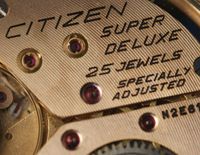
Finally, let’s take a look at the 9200 movement – finished in gold plate the markings clearly show that it’s a Super model:

The Super Deluxe – a high grade hand winding watch which oozes the dress style of its day, and would have represented citizen’s most accurate timepiece at the time just prior to the launch of the Chronometer in 1962.

Posted in Vintage Watches | Tagged , , | 6 Comments

A Little Story About Reliability & Accuracy

If you take a look at the ‘comments’ on the Movement Table page, you’ll see a story from Brian, who bought a watch for his mother in 1972. The watch was used on a daily basis up to a couple of years ago. Brian has measured the watch against his atomic clock over the last few days and found it to be within a couple of seconds per day! Impressive or what? And….the watch has never been serviced!! Pretty remarkable and an impressive tale of reliability and accuracy.

The watch is a Cosmostar V2, a fine little high beat movement running at 28,800 beats per hour. Here’s my example:

Posted in Vintage Watches | Tagged , | 10 Comments