This Week’s Featured Watch #15 – 6501 with Titanium Carbide Bezel

In the early 1970’s Citizen used a range of different materials in their watch cases and bezels. The black PVD coatings began to appear and that soon became an established finish for many sports style models. But Citizen also used some rather more exotic materials, including wood and agate, typically encasing a 6500 / 6501 movement.

My example this week is not quite so unusual as wood or stone, but it does use what I believe is a titanium carbide bezel. The case is marked ‘BLTI’ which suggests a black case with titanium bezel, but my research suggests that the metal used was in fact titanium carbide:

The gold dial lies behind its original horizontally faceted crystal:

After some cleaning the bezel is more like it would have been when first produced (apologies for not cleaning off the lint on this pic!):

The back is marked in typical fashion, and shows production was in October 1972:

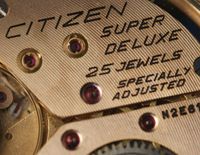
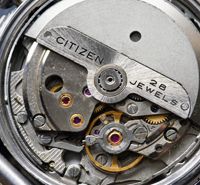
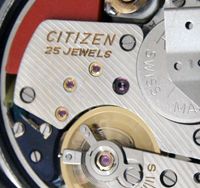
The 21 jewel movement runs at 21,600 beats per hour:

This is an example of the kind of design which emerged in the early 1970’s – not necessarily to everyone’s liking of course, but nevertheless evocative of the period when more traditional design conventions were challenged.

Posted in Vintage Watches | Tagged | 10 Comments

Something to look out for on the 5800

Following on from the last featured watch post on the Cosmotron 5800, I thought I’d point out one of the issues I found with this movement and is something you might want to look out for.

I have three watches with this movement – when I got them two were non-runners, whilst one was in good working order. I found out why two wouldn’t run quite quickly, and it concerns the lower battery connection, which is in the form of a plate located on a plastic base beneath the battery. With the battery removed, the plate is indicated here (this one appears to be bonded in place rather then screwed):

On one of my 5800’s this plate was adrift, on the other non-runner it was missing altogether.  The plate is easy enough to place correctly, since there are two lugs in the plastic base which hold it in place:

Even without a screw to hold it (looks like a screw hole is there for this purpose), and with no glue, the plate is held ok once the battery is in place and tight under the battery holder:

So if you see one for sale as a non-runner, just maybe the lower connection plate is loose and once back in place it’ll fire up just fine as mine did. However, if it’s missing, you’re stuffed of course!

Posted in Vintage Watches | Tagged | 2 Comments

This Week’s Featured Watch #14 – the Cosmotron 5800

In 1966, Citizen launched Japan’s first electric watch – I featured the Chronomaster version of that in Week 10 – and over the next 10 or so years they developed this electro-mechanical technology via the ‘X8’ and ‘Cosmotron’ lines. With the advent of quartz modules this hybrid technology was short-lived, although it seems to have been successful in terms of sales in Japan.

The design of the electro-mechanical movements changed rapidly as the 1960’s ended and the 1970’s began, with an associated reduction in jeweling and to some extent, prices. As the technology was developed, so the speed of the movements increased. The first ‘Electric’ models (0801 / 0802) ran at 18,000 beats per hour, followed by the 0840 and 4840  running at 21,600 beats per hour. Finally, the 78xx series ran at 36,000 beats per hour.

Well, nearly finally that is, since in 1970 Citizen produced their first electro-mechanical watch for women…..enter the 5800 movement, something of a mini-marvel:

With 17 jewels reflecting a higher grade piece, this movement was used in the ‘IC-12’ ladies model – and solid gold versions of this retailed at JPY180,000! The ‘IC’ part stood for  Integrated Circuit, but the more interesting part is the ’12’, since this indicated the beat of the watch, a remarkable 12 beats per second…..or 43,200 beats per hour.

The 5800 movement was / is Citizen’s highest speed watch with a mechanical balance, and was used later, around 1974/5 in a version for men. Here’s the gold plated version, from August 1975:

The small movement is held by a plastic internal case:

This is the stainless steel version:

Produced in November 1974, this one has a different style of case back, one that actually looks later than the 1975 model:

The plain white dials and black frame hands combine well:

And just in is a women’s model from 1970 – sadly not the IC-12 Chronometer version! Only one quick shot so far, to show the size against the men’s model:

The 5800 movement is not so well-known in the Cosmotron line-up, but is an excellent example of the hybrid technology pursued by Citizen just prior to the quartz explosion.

Posted in Vintage Watches | Tagged , | 24 Comments

This Week’s Featured Watch #13 – the Crystate Deluxe

My first ‘featured watch’ was the Crystate, a seldom seen hand winder from the late 1960’s. At the time I commented that it would be very nice to have the deluxe version in my collection…..

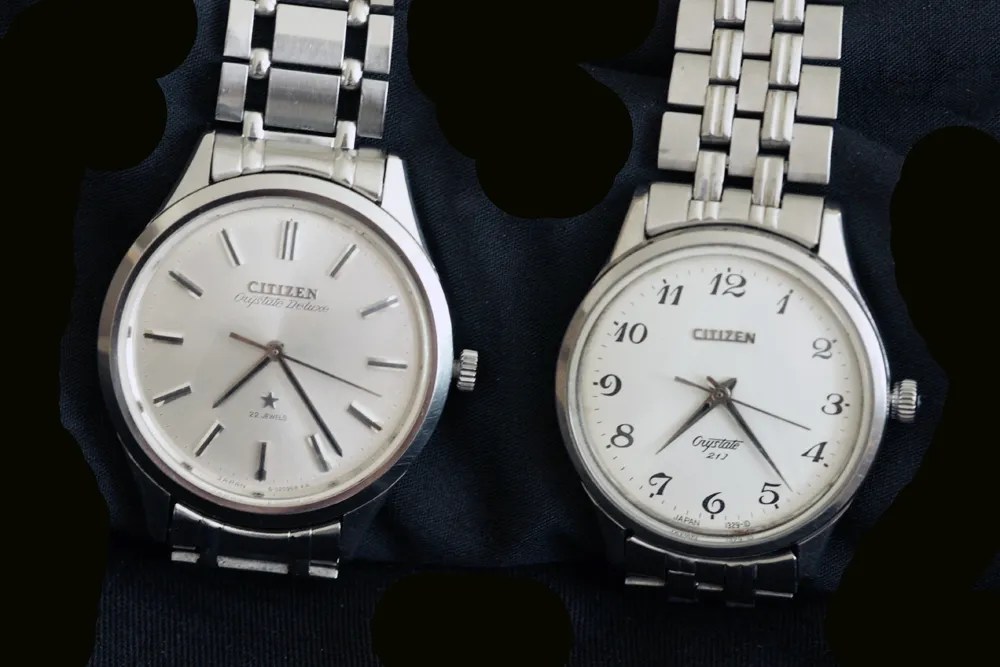
I was fortunate to find one recently, in very good condition, and is one of only a couple I’ve seen for sale. Again a hand winder, the Crystate Deluxe is distinguished by a single applied star on the dial, and one more jewel in the movement:

The movement hacks, and the above pic shows the crown in the hacking position. The movement finish is unique to the Crystate:

The back is engraved, looks like this piece was either presented to an employee for long service or maybe  it commemorates a milestone in a company’s history, and shows production in May, 1969:

The dial is well finished, with hands and hour markers detailed in black:

The addition of one star on the Deluxe model is unusual – prior to this the ‘super’ variants often had three stars to help differentiate them from the standard versions.

I think the solid link bracelet is original to this watch:

Here are the two versions together – the Deluxe is slightly larger – and I’m  pleased to say both are very good timekeepers:

Posted in Vintage Watches | Tagged , | Leave a comment

Back After Vacation….

….had a great two weeks in La Belle France, enjoying the beauty and cuisine of Brittany. Since this isn’t a travel blog I shall say no more, except to mention the watch I took with me of course!

My holiday watch was a 1970 Seven Star V2 beater – with it’s well worn case and bezel this is no great beauty, but it is a superb time-keeper. After two weeks it was spot on, with no adjustment at all required, just as it had been on a similar trip to Italy over two years ago:


The 7280 movement in this 23 jewelled one runs at 21,600 beats per hour:


There’s something appealing about a fairly ordinary and well-worn vintage watch that runs at chronometer standard!

Watch this space for the next Featured Watch, which will be a somewhat rarer model than the V2….

Posted in Vintage Watches | Leave a comment

This Week’s Featured Watch #12 – the Uni Auto Dater

Last week’s feature was the SM, using one of the early swinging weight type of movements Citizen introduced to replace the Jet. In fact, it was the second model to use this type of movement – it was preceded two years earlier in 1963, when the ‘Uni Auto’ was launched. Two versions were produced, the Uni Auto with a plain dial, and the Uni Auto Dater with date window. The movement numbers are respectively 1400 and 2400, both with either 17 or 19 jewels. My example is the 17 jewel autodater:

Made in April 1965, the back is plain:

Inside, the 2400 movement is simply signed, with no detailed finishing. Typically for that time, the watch runs at 18,000bph and unlike the later SM models, there is no date quick-set mechanism:

Citizen gave the Uni Auto’s a unique logo:

And this model is rated to 40m:

The original retail price of these ranged from JPY5,500 to JPY7,200, so were relatively inexpensive watches, presumably to have mass market appeal.

Posted in Vintage Watches | Tagged , | Leave a comment

This Week’s Featured Watch #11 – the SM

After the first Citizen automatic in 1958, which used a conventional swinging weight rotor to drive it, the company launched its ‘Jet’ rotor, with a distinctive circular gear. By the mid-1960’s Citizen dropped the Jet and returned to the oscillating weight design – possibly because it proved more reliable, but most likely because it allowed thinner movements to be made.

One of the earliest models to use the oscillating weight is the ‘SM’ Autodater, which came in just two date only flavours – 17 and 21 jewels – and is built around the 2410 movement:

These examples typically illustrate the different styles of the day – the 17 jewel model has lumed hands and hour ‘dots’, whilst the 21 jewel model has the fancier bezel. And the backs also show two styles – the 17 jewel one from February 1966 is on the left, whilst the 21 jewel version with a more modern looking back is in fact a little older, produced in September 1965:

These were not high end watches, costing  JPY6,800 (17j) and JPY7,800 (21j) at the time, so the movements are plain, with no special finishing. Notably the rotor on this early auto is attached with a central screw allowing removal by a screw driver – this was later changed to a different design. Typical of Citizen’s automatics these hand wind as well – note the movement number stamped under the balance wheel in the second picture:

The later rotor screw design for comparison:

Date changing on the SM Autodater is novel – when the crown is pulled out to move the hands the date is changed by rotating backwards – anti-clockwise – which is something I’ve not seen in any other watch.

Finally, why call this the ‘SM’? Without the benefit of detailed translation, it looks that this may have been an abbreviation of ‘slim’ – reflecting that this design enabled thinner movements and cases.

Posted in Vintage Watches | Tagged , | Leave a comment

This Week’s Featured Watch #10 – The Electric Watch

To reflect my intention to provide a representative sample of Citizen’s vintage watches over these early weeks of the blog, this week I’m featuring their first electric model. Launched in March 1966 not only was this Citizen’s first such model, it was also Japan’s first electric watch. With a battery and electronics replacing the mainspring, the movement uses a conventional hairspring and balance, with a fine adjuster indicating that this watch is capable of a high level of accuracy – in fact one version of the Electric Watch was to chronometer standard.  At a time when mechanical watches were the standard, this model was seen as ground breaking since it required no winding and would run for at least a year before a battery change was required.

This was an expensive watch when it first appeared, retailing at over JPY30,000 – only the 18k gold Chronomaster was more expensive in the 1970 men’s watch line-up. The first model has a unique case design and was known as the ‘Electric Watch’ – this name featured on the dial as well as the logo ‘X8’. Shortly after this first model Citizen renamed it as the ‘Chronomaster X8’ and added a chronometer grade variant too. The unusual case shape was recognised at the time as it won a design award in Japan.

The technology was to evolve quickly, as did the name, with ‘Cosmotron’ being adopted for the range of electro-mechanical models. Although the X8 logo continued for a while it was eventually dropped (I’ll be adding a page to the blog in due course about the Cosmotrons, so more information on the line and the development of the movements will be available then).

In summary then, and as far as I am aware, this first electronic model can be found in three versions – the very first ‘Electric Watch X8’, the ‘Chronomaster X8’, and the ‘Chronomaster X8 Chronometer’.

My version is the Chronomaster X8 – the unusual case shape is radially brushed on the top:

The dial is finished in silver, with black hour markers and black centres to the hour and minute hands:

The unique case back design, unfortunately badly scratched, shows 1968 production – I believe the mesh bracelet is original to this watch, it certainly matches the 1970 catalog picture:

The case back requires  a special tool, along with special case holder:

Inside is the 0821 movement, with 25 jewels even though the mainspring has been replaced by a battery and solid state electronics. This movement runs at 21,600 beats per hour, and the fine adjuster can be seen on the balance:

A small recessed crown allows the movement to be ‘hacked’ when pulled out to adjust the time, by disconnecting the battery:

And finally, why the ‘X8’ name? Well, bearing in mind the limitations of on-line translation, it appears that as ‘X’ can mean an ‘unknown’ and ‘8’ (although derived from the caliber number) when on it’s side is similar to the infinity sign, Citizen suggested that they were rising to the ‘infinite challenge of the unknown’ – or something like that!!

Posted in Vintage Watches | Tagged , | Leave a comment

Movement Table Updated

Doesn’t time fly! I published Version 2.0 back in October 2010, so with a bit more knowledge gained since then, I’ve made a few amendments and additions, so V2.1 is now available.

Please let me know if you think there are errors and omissions – I’ll be more than happy to edit the table accordingly if verifiable information is available.

Access to the new version is via the Blogroll link…..

Posted in Vintage Watches | Leave a comment

This Week’s Featured Watch #9 – The Seven

I thought after last week’s Crystal Seven, and my mention of the ‘Seven’ name being used on autodaters and a hand winding watch, that I’d follow this week with that hand winding model. Rather than ‘seven’ being part of the model name, this one is uniquely called the ‘Citizen Seven’.

First produced in 1964, the Seven uses the 4000 movement, only seen in this model and one other – the Young Date – with 23 jewels.

As far as I can determine, two models were produced – the relevant ‘museum’ book shows this one, which was also made in a gold plated case:

In my view this version is not one of Citizen’s most memorable designs, however the other model, and the one I have in my collection has a  much more pleasing look, and shares the blue applied ‘7’ logo with the Seven Autodaters:

The shield shaped day window,  with wheel printed in both English and Kanji, is unique to this model, as is the printing font used:

The name and font style are repeated on the on the case back:

Made in April 1966, the back is marked with an ‘X’ – this may refer to this being a front opening case. As a result I can’t post a picture of the movement in this one.

The day is a ‘semi’ quickset by winding back and forth between 12 and 9, whilst the quickset date is changed by pulling the crown in and out at the second click. This also means that the hands are moved by pulling the crown out just one click. The downside to this design is that it is possible to accidentally advance the date if you want to adjust the hands and pull the crown out a little too vigorously!

The crystal is thick glass, and all models are rated at 40m water resistance, and run at 18,000 beats per hour. When new these (at least the model shown in the book) cost nearly JPY9,000.

Posted in Vintage Watches | Tagged | 19 Comments