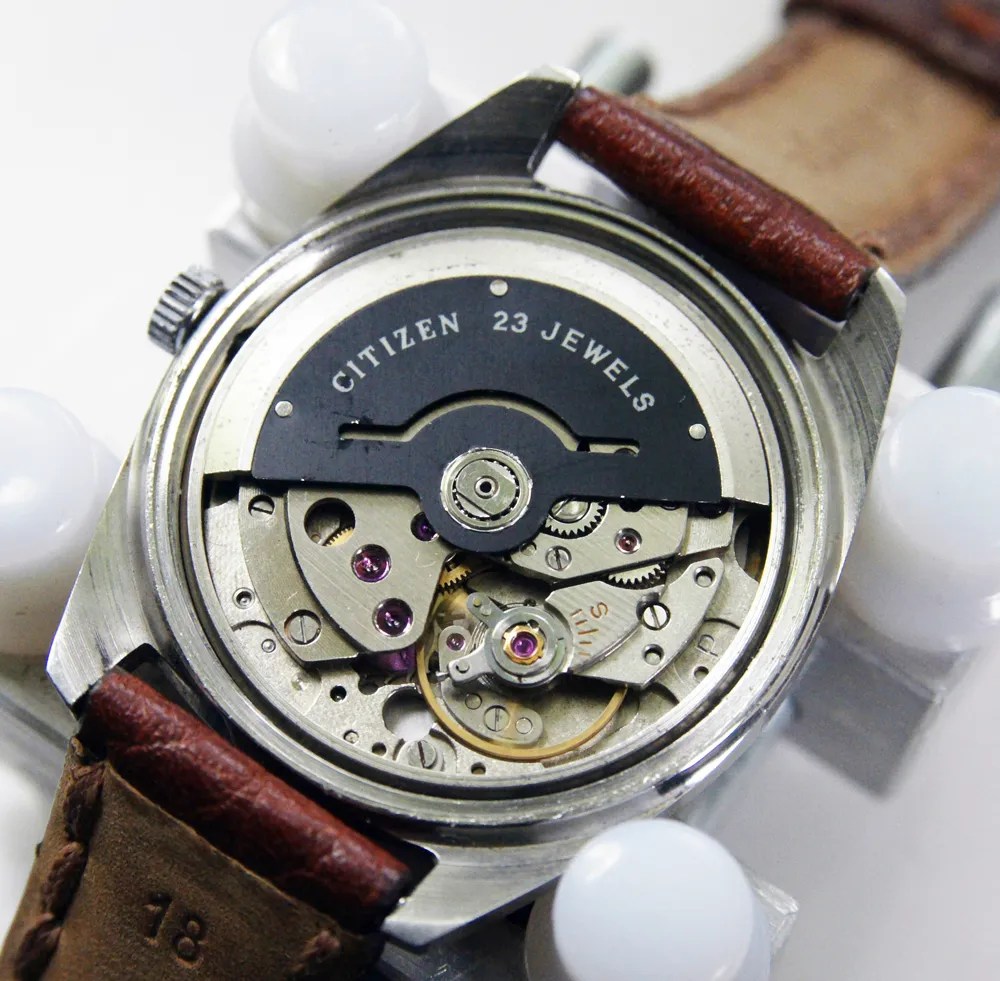
Score Counter and a White Strap? It’s a Challenge Golf

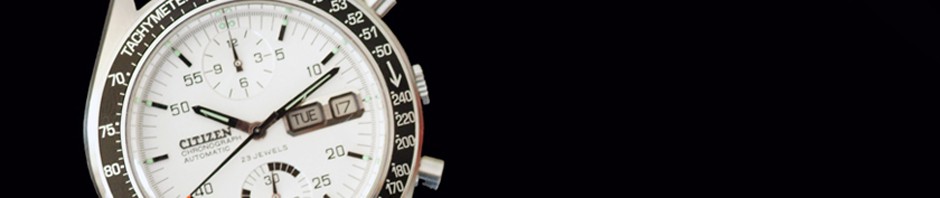
The ‘Challenge Golf’ is one of Citizen’s more unusual watches.  First produced in 1972, it features a score counter at the 12 o’clock position and crown at 8 o’clock. Here’s a scan of marketing material from October 1972:

Also unusual is the white strap on these two versions of the ‘tv’ dial model. Once or twice I’ve seen these for sale still on the original strap, but it’s clearly something that will deteriorate quickly if used regularly.

Here’s a catalog scan from 1972, with my example of this shape:

Note the price – these are high-ish end watches, with a high beat movement (7760) running at 28,800 beats per hour, which originally retailed at about the same price as the 8110A Challenge Timer chronographs, and more than the 8100A chronographs which were launched at the same time.

Citizen also produced a round dialled model, again with black case and with either a stainless steel or a gold bezel. The green shades of the dial also varied  between the gold and steel models – see the catalog pic. Here are my two together:

An interesting piece that had only a short production run at the time golf was becoming ever more popular.

Here’s more info from the ‘Featured Watch’ series: https://sweep-hand.org/2011/06/07/this-weeks-featyured-watch-6-the-challenge-golf/

Posted in Vintage Watches | Tagged , | Leave a comment

Citizen’s 67-9151 Chronograph – Dial Versions and a Puzzle Solved!

For a long time, along with Brian aka ’31Jewels’, I’ve been puzzled by some of the examples I’ve seen of the 67-9151 chronograph. Some of the dials looked much paler, and lacked orange highlights on the sub-dials. I’d wondered if these had faded in the sunlight over the years…..

This puzzle has now been solved, thanks to Brian finding a scan of a leaflet about the 1974 67-9151, which very nicely shows that there were in fact three versions of the dial. All of them have the main dial colour of green, but the sub-dials were bordered either in yellow, yellow and white, or yellow and orange:

Other variations are the yellow second hand to match the all yellow sub-dials, whilst it was orange on the other two types, and ’23J’ used on the yellow and white one.  Note as well that the orange sections of the sub-registers are the opposite sides to the white ones.

I’ll add this to the Chronographs reference page 🙂

Posted in Vintage Watches | Tagged , , | Leave a comment

This Week’s Featured Watch #59 – Super Flat Seven Auto Dater, 23j

Citizen moved from the Jet automatics, with their circular geared rotor, to the more usual swinging weight design in the mid-1960s. Although the first Jet automatics with no day or date complications were a reasonably slim design, the later models with date or day and date had to be housed in rather deep cases.  This was also true of the very first swinging weight models, as used in the ‘UNI’ (2410) and ‘SM'(4600) auto-dater models. However, Citizen was able to produce slimmer watches with the advent in 1965 of their 52 family of movements.

The Crystal Seven range is probably the best known of the 52 movements, but there are a number of other models, and one rather scarce example is the ‘Super Flat’. The name reflects the slimmer case design facilitated by this movement – my example houses a 5203 movement, with 23 jewels. So far I have only seen a few examples, all with 23 jewels:

The main dial logo is printed rather than applied, and on one example I’ve seen the ‘Super Flat’ name was printed in blue. The applied ‘7’ logo is also found on the crystal seven – the ‘seven’ refers to watches with day and date complications and was first used on earlier Jet automatics. The crystal is plastic with a ‘cyclops’ lens over the date.

The back is what I call a transitional design marked with the older style model number – APSS 52703. I believe the ‘P’ references the plastic crystal – if this were a Crystal Seven the model number would be ACSS 52703:

The serial number gives a production date of July 1967. Inside is the 23 jewel movement, and as with many of Citizen’s 52xx and 72xx automatics the centre of the rotor is black:

Shots of the sides of the watch illustrate the slim design:


And here you can see this watch at the bottom of the stack, to show how it compares to earlier models:

The Super Flat is a relatively recent addition, so I now need to update the Movement Table and 52 Crystal 7/Seven Star Family Tree to include it.


Posted in Vintage Watches | Tagged , , , | 3 Comments

Citizen’s So-called ‘Compressor’ Diver

One of Citizen’s vintage divers, the one with two crowns and an internal rotating bezel, is usually referred to as a ‘compressor’, or ‘compressor type’ diver:

I’m not a dyed in the wool diver enthusiast, so to be honest I have adopted this terminology without too much thought… However, I’ve recently had some very helpful comments about this model, from a chap called Hunter. Rather than leave this in the comments thread on the divers page, I’m bringing the key points here – particularly since it is clear to me now that I shouldn’t be referring to these as ‘compressor’ divers at all.

Here’s what Hunter brought to my attention:

“Compressor” watch cases were patented by EPSA and came in three styles. They refer specifically and only to the case sealing method and, as some might correctly assume, the greater the depth underwater, the tighter the case becomes.

One fact needing greater attention is that the third compressor patent (Super Compressor) is usually found on dive watches from the 1960s and early 70s. Dual crowns are used with an inner rotating bezel with the upper crown rotating the bezel. However, Super Compressors come in single crown versions. 

Bottom line is that a watch with twin crowns is exactly that. Unless you find the specific EPSA designed technology (and brevet numbers or at least their diving helmet logo) you do not have an EPSA “Compressor” case.

The Swiss case manufacturer Ervin Piquerez S.A.(EPSA) patented the technology for compressor cases. Hunter provided this link for more EPSA information (and to see some very nice watches too 🙂 ):

http://scubawatch.org/EPSA_SC_FAQ.html

Having now had a closer look at the EPSA designs following Hunter’s comments, it seems to me (although I’m no watch techie) , that Citizen’s so-called ‘compressor’ is not in fact a true compressor diver. To be fair I don’t suppose Citizen called it that, they simply designed a twin crown model in line with the fashion trends of the day.

Since my intention all along with my own collection and this blog is to build reference information on original Citizen watches that is as accurate as possible, I’ll be editing references to the ‘compressor’ diver,  replacing it with ‘twin crown’ diver.

With thanks to Hunter 🙂

Posted in Vintage Watches | Leave a comment

Citizen’s Demonstrations of their Parawater Watches, Part 2

There is more information, and more photos, on these trans-Pacific tests on the SCWF, posted by ‘Akable’ :

http://www.thewatchsite.com/21-japanese-watch-discussion-forum/97330-how-convince-customers-watch-waterproof-post758826.html#poststop

Stephen

Posted in Vintage Watches | 2 Comments

Citizen’s 1964 Demonstrations of their Parawater Watches

In 1959 Citizen introduced Japan’s first waterproof watch, and they adopted the name ‘Parawater’ for the case and crystal design. The first model to use this technology was a Deluxe hand winder – see here: https://sweep-hand.org/2012/01/22/this-weeks-featured-watch-20-the-parawater-deluxe/

By the early 1960s Citizen were producing automatic watches, using the ‘Jet’ rotor, and in 1964 the company staged an impressive demonstration of both the waterproof capability of their design and of the automatic winding mechanism. They did this by chucking them in the ocean! It a bit more sophisticated than that of course 🙂  A special buoy was designed to hold each watch, which ensured that the watch was held just below the surface whilst the motion of the waves kept them wound – here’s a cross sectional diagram of the buoy:

These buoys, loaded with Parawater Jet Automatics were then thrown from boats in the Sera of Japan and later in the Pacific:

I don’t know how long these buoys made their oceanic way – the trans-Pacific ones must have been at sea for a considerable time:

Of course at the end of their voyages, the watches were found to be happily ticking away 🙂

Here’s the notice on the top of the buoys:

Nice sentiment, nice test 🙂

Posted in Vintage Watches | Tagged , , , | 2 Comments

Citizen’s Challenge Timers – Just the ‘Bullheads’?

Citizen’s best known vintage mechanical chronograph is usually called the ‘bullhead’, a name that is of course not specific to the Citizen brand. The correct original name for Citizen’s bullheads was ‘Challenge Timer’, but only recently I have found that this name in fact applied to all their chronographs. Here’s a scan from October 1972 marketing material, showing two of the 8100A single register chronographs (NB: I think the blue cast is caused by the printing):

1972 was the year Citizen launched their chronograph watches – so this image was part of the regular newsletter to dealers which presented, among other things, the new models they would be selling. I believe the 8100A was launched first, with the 8110A following in 1973 (gleaned from Citizen’s own historical information).

Here are the same two models in the 1972 catalog, with retail prices (about JPY5000 less than the 8110A two register models) – these images are also good for showing the original bracelets these models came on as well as the type of case finish (NB: note dials both look to be black in this image, I’ve not seen any examples of this model with a blue dial):

These two are variants of the same model, which had no ’67-xxxx’ model number, only a case number – 4-900014 – so these may have been the first of the range.

My own example is from May 1972 – it was made that month, but these were first sold, according to Citizen, in October of that year (which fits with the date of the marketing material):

The back gives the early production date:

Posted in Vintage Watches | Tagged , , , | 10 Comments

8110A Restoration Page – Final Update

Just added the final instalment of 31 Jewels’ excellent restoration page.                            Well worth a visit 🙂

https://sweep-hand.org/brians-8110a-restoration-the-speedy-67-9313/

Posted in Vintage Watches | Leave a comment

This Week’s Featured Watch #58 – Jet Automatic, 21j

The ‘Jet’ range of automatics was introduced by Citizen in October 1961. They used their in-house movement with circular, geared rotor and were made until around 1965. The first movement was the 0310, with 21, 23 or 25 jewels with no date or day complications. My example of this one is a new arrival, and is in very decent condition. The gold plated case has stood up very well, the older plating seems to be better quality than we see in the 1970s:

There are a few scratches on the glass, but that can probably be improved with a little polishing, especially since it’s acrylic. The dial printing is very fine:

The back is well worn, aided and abetted by rather shallow engraving – this shows that the watch has been well used, evidencing the quality of the plating on the case:

At the right angle the markings can just about be made out, from ‘STAR’ (the case factory name) at the top to the case number, JT15803, at the bottom. On the inside of the back, free from wear of course, we find the serial number, giving a production date of August 1962. There is also evidence of servicing work being done:

The movement looks to be in good condition, and is running well, keeping good time:

It’s always good to open one of these up 🙂

More info on the Jet auto’s here: https://sweep-hand.org/the-jet-automatic/


Posted in Vintage Watches | Tagged , | Leave a comment

Jet Family

Here’s a group shot of my Jets – the most recent arrivals are the two on the left, the early plain dialled model and the Rookie. SONY DSC

The Jets use Citizen’s circular geared rotor rather than the more usual swinging weight. The three years covered by this group – 1962 to 1965 – pretty well covers the production run of these automatics. By 1964 the UniAuto was in production, with a swinging weight rotor, marking the beginning of the end of the Jet.

More info can be found here: https://sweep-hand.org/the-jet-automatic/

Posted in Vintage Watches | Tagged , , | 2 Comments