The restoration reaches its conclusion – and the performance of the watch on the timer is impressive…
https://sweep-hand.org/brians-8110a-restoration-the-speedy-67-9313/
The restoration reaches its conclusion – and the performance of the watch on the timer is impressive…
https://sweep-hand.org/brians-8110a-restoration-the-speedy-67-9313/
I’ve featured a Cosmotron GX before – Number 33 in the series – but I have a second example. This one grabbed my attention since it has an unusual dial, featuring a textured green finish and contrasting white chapter ring:

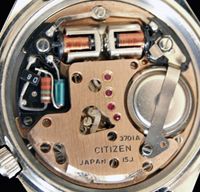
The GX has a single coil tuning fork movement, so is a bit of an anomaly in the Cosmotron line-up since they are normally powered by an electro-mechanical movement. This example was made in 1975 – the movement number is 3701B, with 11 jewels:

As with the Hisonic tuning fork model, the second hand sweep is very smooth, at 360 beats per second. The hands on this GX are nicely finished, with white centres, and are a little clearer in this shot:

More info and movement shots: https://sweep-hand.org/2012/05/21/this-weeks-featured-watch-33-the-cosmotron-gx/
Identifying Citizen’s many models can sometimes be challenging – and it’s made more so when the watch appears not to carry the expected model markings. At first it seems that the watch might be a fake or a re-dial – and sometimes this may of course be true! But it’s worth knowing that as early as the 1960s Citizen was exporting watches well beyond the Japanese domestic market, and sometimes their watches are marked differently. What I’ve noticed is that usually the model name is dropped from the dial. For example, here are two auto-daters that would normally carry the ‘540’ or ‘520’ name below the 12 0’clock marker:


As you can see from these two, they carry the ‘Waterproof’ mark rather than ‘Parawater’, and ‘Shockproof’ rather than ‘Parashock’, another indication that these were for export.:

The 02 ‘Homer’ movement was often used in export models, and it’s not unusual to see this type of dial, marked ‘water protected’ (a lower level of protection than waterproof) and ‘unbreakable spring’ :

Here’s a woman’s watch marked in a similar way, this time with a 1910 movement, from 1967 – this movement was used in the ‘Excel’ watches sold in Japan :

The back carries lots of information!:

The situation gets more complicated further by the use of a different model name. In this example, with thanks to Pete in New Zealand for sending the pics, an automatic with the 5470 movement usually seen in the ‘Crystal Date’ is given the ‘Newmaster’ moniker:


Again the back is marked waterproof, whilst the case number is consistent with the movement inside:

Citizen used the ‘Newmaster’ name across a range of automatic and hand winding models – most frequently it’s seen on the early 1970s hand winders with ‘Homer’ movements.
Finally, one model name that I think has been used only on export models is ‘Super King’. I’ve seen it with a Jet auto as well as the 52 & 54 movements. As far as I know, so far at least, this wasn’t a model sold on the Japanese domestic market:

As Brian’s work continues we see the result of case cleaning and refurb of the pushers:
https://sweep-hand.org/brians-8110a-restoration-the-speedy-67-9313/
Well, after putting the black dialled 67-9038 together and being pleased with it, I have now learned an important lesson! i.e. it’s always worth studying parts under magnification. I was keen to get the piece together, so I’d only looked at the dial with the naked eye. However, Markus (see his comment on the original post: https://sweep-hand.org/2014/02/18/a-little-project-black-dial-67-9038-chronograph-sorted/) is aware that after-market dials are now available for this model. This was news to me, since I only knew of the Challenge Timer (‘bullhead’) after-market dials. So of course I immediately had a close look, and Markus is absolutely right!
Markus explained that the difference to look for is that the applied ‘Citizen’ logo is bigger on the after-market dial, and indeed it is. I also noticed though that the printing is of a poorer quality, being less fine than the original.
So lesson learned, always be on the look out for such things if you are looking for original parts, and don’t assume, as I confess I did, that the only after-market parts for Citizen’s vintage chronographs are for the bullhead. Fortunately I’ve not spent much money on this, so I have a beater I can use – the movement seems fine, keeps good time and all works correctly – and maybe a genuine dial will turn up some time!!
I’ve had a spare 67-9038 (8110A chronograph) case lying around for some time. On an original solid link but somewhat stretched bracelet, it has been polished a little over zealously, and the black bezel had also been polished back to metal. Still, it seemed usable to me so I’d been looking for a dial and movement for it, but nothing had come up for at least a couple of years. Then last week I spotted an eBay auction……
Although the auction images didn’t show a 67-9038, it did show what looked like a very nice black 67-9038 dial and hand set installed in a black case. I could see this was from a 67-9551 (single register 8100A model), whilst the back was from a 67-9020. All looked to be in good condition though. So I bid for it, and was successful 🙂
The watch arrived today, so I set to work to transplant the movement and dial – fortunately this is an easy process given my limited technical skills. After I had seen the auction I decided first to paint the bezel on the case. I used my pristine blue dialled 67-9038 as a reference to do this – the finish of the bezel is what I would describe as ‘semi-gloss’, not matt, satin or full gloss. I mixed gloss and matt enamel paint to get as close a match as I could. It won’t be very durable, but it will look authentic! I also got a new crystal since that was missing from the case.
Here’s the donor watch, which actually looks rather nice:

As you can see that dial looks very good indeed (edit: well, it does, but it turns out that it’s an after-market dial…see separate post). The original bezel on this case should be polished metal, and this one has been painted – note the chip which the seller was very clear about in his auction description. The case back, although from a different model, is also in very good condition, as is the black case:

Once I had removed the movement I could see that the bezel was a later addition to the case, rather than the original one, which explains why it had been painted.
So what is the result? In my opinion a perfectly wearable 67-9038:

The stem and crown from the donor watch do not fit the 67-9038, but since it shares these parts with the 67-9313 ‘Speedy’, I’ve used them from a second ‘Speedy’ I have for now.
Here it is alongside my blue example:

I also want to add a few words about the seller – often sellers of non-authentic watches get a lot of stick, sometimes rightly so when they present them as ‘all-original’ and a ‘must-have for any collection’ . However, after contacting the seller (who made no such claims) I’m sure he had no reason to think it wasn’t authentic, given that a fair bit of knowledge is required to properly identify them. He has been very positive when I explained the issues about the watch and has visited the blog 🙂
See the latest update, as work begins on the hands: https://sweep-hand.org/brians-8110a-restoration-the-speedy-67-9313/
The latest instalment is now added to the page – this time taking a closer look at the dial and the challenges it presents https://sweep-hand.org/brians-8110a-restoration-the-speedy-67-9313/
The majority of Citizen’s watches were originally sold with steel bracelets, sometimes gold plated, sometimes black. Although some bracelets are very nice, and it’s good to have an original one fitted, I confess to a preference for leather straps. I find them more comfortable and in my opinion they can look better than steel. Living in the UK with its cool climate, leather is also ok for the prevailing conditions.
One of my watches that came on a non-original bracelet is the Deluxe ‘Parawater’ – this was Japan’s first waterproof watch, first made in 1959. The steel bracelet was in decent condition but did’t have suitable end links:

And looking at my reference material, the watch is shown on leather as well as a steel bracelet – so I changed it today:

Although ‘Parawater’ clearly refers to keeping liquids out of the watch, a UK Citizen sales person’s hand book I have – from around 1968 – emphasises that the basic proofing (i.e. to 10 meters / 1 atmosphere) is good to keep dust out, thus better preserving the quality of the oils.
After a comment from Bogdan I realised that I hadn’t had the back off this one – so just did that, and pleased to see a nice low number on the movement. I don’t know how Citizen determined the number though….

I’ve just added Parts 4 & 5 of Brian’s ‘Speedy’ restoration to the page: https://sweep-hand.org/brians-8110a-restoration-the-speedy-67-9313/
If you aren’t already a follower of the blog, please sign up so you get an email alert each time there’s an update 🙂

 | askthe8ball.com on Blog Update – August… |
| askthe8ball.com on This Week’s Featured Wat… |
 | sweephand on Vintage Citizen Case Backs… |
| sweephand on Brian’s 8110A Restoratio… |
 | Saravanan on Vintage Citizen Case Backs… |
 | Courtney Blackwell on Brian’s 8110A Restoratio… |
 | Alejandro Larragoiti on Automatic Chronographs |
| sweephand on The 8200 Movement – Citi… |
| sweephand on Vintage Citizen Case Backs… |
| sweephand on This Week’s Featured Wat… |
| sweephand on Vintage Citizen Case Backs… |
 | Dave on The 8200 Movement – Citi… |
 Sweephand’s Vintage Citizen Watch Blog

 Sweephand's Vintage Citizen Watch Blog